
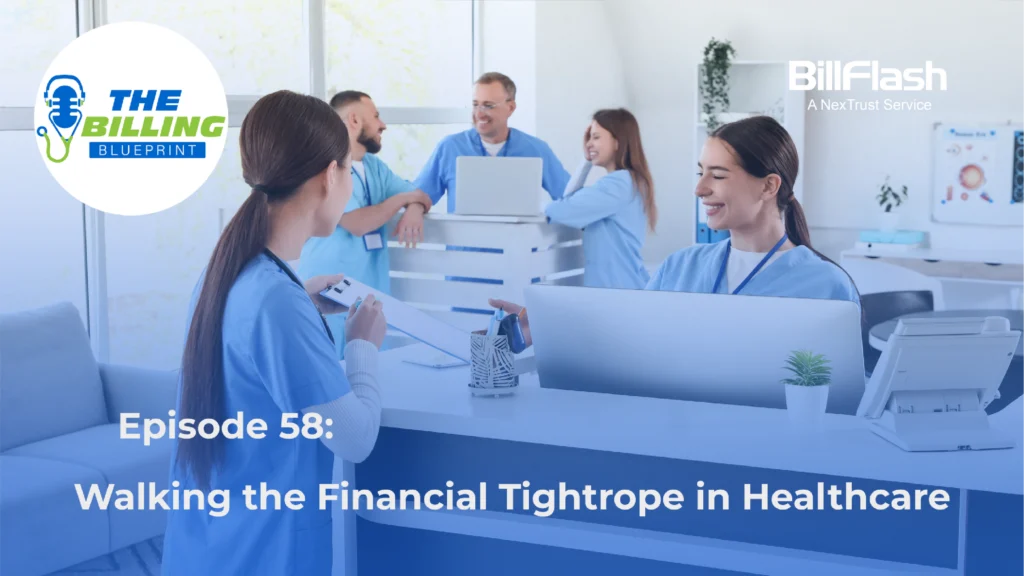
Practices and patients are walking on the financial tightrope. Rising deductibles, growing medical debt, and delayed care are putting patients and practices under pressure at the same time. In this episode, we dig into what’s really driving today’s healthcare payment crisis—and why traditional billing models are no longer working.
We explore the hidden operational strain practices are facing, the real cost of unpaid patient balances, and how smarter payment structures are changing the conversation around affordability and access to care.
If you’re navigating patient payments, rising A/R, or the shift toward patient responsibility, this conversation will change how you think about healthcare billing.
Listen now to understand what’s breaking—and what’s finally working.
Transcript
Narrator: 00:00
Welcome to the Billing Blueprint Podcast, your go to resource for innovative medical billing solutions. Each episode we explore the latest industry trends and share proven strategies to help your practice streamline operations and get paid faster. Now here are your hosts, Brad and Sarah.
Sarah: 00:21
Welcome back to the Deep Dive. Today we are walking a, well, a kind of financial tightrope, the one strung right across the modern American healthcare system. For years, you know, we've talked about rising insurance premiums, but the core challenge, it feels like it's shifted. It's now hitting patients and providers at the exact same time.
Brad: 00:42
It truly is a dual crisis. I mean, one side, you have the patient who is increasingly burdened by these really high deductibles and, you know, massive out of pocket maximums.
Sarah: 00:53
Right.
Brad: 00:54
And on the other side.
Brad: 01:00
On the other side, you have the healthcare practice just trying to operate a business. You know, they're delivering excellent care, but they're finding it, well, nearly impossible to collect what they're actually owed.
Sarah 01:10
So really, the mission for us today in this deep dive is to get our heads around just the staggering scale of this financial burden.
Brad 01:18
Right. On both sides, you've got the human cost and then you have the, you know, the operational cost for the practice.
Sarah 01:23
Exactly. And then from there, we can really start to analyze the structural solutions that are out there, the ones designed to help practices, you know, stay afloat while.
Brad 01:34
Still making sure patients can actually afford to walk in the door and get treated. Yeah, it's a foundational shift in how healthcare is paid for.
Sarah 01:40
How so?
Brad 01:42
Well, the money used to primarily come from large, predictable insurance carriers. Now it comes in much smaller, less predictable chunks from hundreds or even thousands of individual patients.
Brad: 00:00
Now it comes in much, much smaller, less predictable chunks from hundreds or even thousands of individual patients.
Sarah: 01:54
And that just changes the whole operational model completely. Okay, let's unpack this by looking at the staggering numbers driving this challenge. Because the sheer scale is. It's just overwhelming.
Brad: 02:06
It is overwhelming. And the data shows we're dealing with a healthcare economy that is just consuming an increasing share of the nation's wealth. If you look at the 2023 data, total national health expenditures, or NHE, grew by a massive 7.5%. It reached $4.9 trillion.
Sarah: 02:23
4.9 trillion. That figure is so large, it's almost, you know, meaningless until you break it down.
Brad: 02:28
Exactly. When you contextualize it, that's approximately $14,570 spent per person in the US per person. And critically, it represents 17.6% of the US gross domestic product.
Sarah: 02:40
Yeah.
Brad: 02:41
Healthcare spending isn't just a line item in a budget. It's a dominant sector of the entire American economy.
Sarah: 02:46
And what's fascinating here is how that macro trend, this giant accelerating economic growth, how it filters down into specific policies that affect real families. It shows up in programs we all rely on, like Medicare.
Brad: 02:59
Right. Even programs that were designed to cushion the burden are now shifting more of that risk onto the individual. A perfect, very recent example is the Medicare Part A inpatient hospital deductible. What happened there, it increased by $44,000 to $1,676 in 2025.
Sarah: 03:15
Okay, so $44 might not sound like a huge jump to some people.
Brad: 03:19
It might not. But for a senior citizen living on a fixed income, that extra $44 tacked onto every single hospital admission, that is a significant new financial obstacle.
Sarah: 03:28
That one data point really shows how this trend of shifting costs onto the patient is just. It's relentless. And when we connect these macro figures to the individual experience, that's where the analysis becomes. Well, it becomes a personal crisis story.
Brad: 03:42
It absolutely does. The financial anxiety is real, and it's widespread. There was a Commonwealth Fund survey that showed nearly half of adults, 48% with medical debt, are struggling to pay off $2,000 or more.
Sarah: 03:55
$2,000 is a lot of money. For most families.
Brad: 03:57
It is. And the truly chilling part, Half of those people report that this debt came from a single hospital stay.
Sarah: 04:04
Just one visit, one illness.
Brad: 04:06
You get sick once, and your financial life can be completely derailed for years.
Sarah: 04:11
That unexpected two, three, maybe $5,000 bill, that's the wall patients hit. It's the moment they realize they just can't afford to be sick.
Brad: 04:19
And when they hit that wall, they make dangerous choices, which leads to the big consequence, delayed care. And this is where the financial issue becomes a genuine public health crisis, not just, you know, a billing problem. The statistic is stark. 28% of adults reported delaying or just avoiding necessary health care in 2023 because of the cost.
Sarah: 04:37
28%. Think about what that means. People are rationing their health.
Brad: 04:41
They are. And that creates the destructive, predictable cycle that ironically costs the system more money in the long run.
Sarah: 04:50
Right. So you have a patient with diabetes or hypertension. They skip their routine visits. Maybe they skip their medications because they can't afford the co pays today.
Brad: 04:59
And they are dramatically increasing their chances of needing intensive, expensive emergency care or a long hospitalization later on.
Sarah: 05:09
So everyone loses. The patient's health gets worse, and the system ends up paying way more.
Brad: 05:13
Exactly. The practice, the hospital, the public health system, they end up absorbing these astronomical costs of treating a crisis that could have been prevented with, you know, cheap routine care.
Sarah: 05:23
Okay, so the patient is delaying care. Let's flip that coin. What does all of that rising patient responsibility and the bad debt that follows, what does that actually do to the operations manager trying to run a course? Quality practice every day?
Brad: 05:36
This is the other side of the crisis. The shift in practice economics is monumental.
Sarah: 05:41
So what's changed?
Brad: 05:42
Practices used to rely on these large, predictable payments from big centralized insurers. Now the operational team have to chase payments from hundreds of individual patient accounts, each with different, you know, ability to pay dynamics.
Sarah: 05:56
It's like they're no longer just a service provider, they're a collections entity. Practices really do feel like they've unintentionally become lending institutions, just holding these huge accounts receivable tied up in patient debt.
Brad: 06:09
That analogy of a lending institution is perfect. And the drain on the bottom line is substantial.
Sarah: 06:14
I can imagine.
Brad: 06:15
What's fascinating here is just how low the collection rate is. Despite all the administrative hours spent, many practices only manage to collect maybe 50% to 70% of what patients owe them.
Sarah: 06:27
50 to 70%?
Brad: 06:28
Yep. That remaining 30 to 50% is either tied up for months in slow moving collections, or it just has to be written off entirely as bad debt.
Sarah: 06:36
And when a practice writes off, say 30% of its revenue, that's cash they can't use to invest in new equipment or give raises to staff or, or.
Brad: 06:45
Just keep the lights on. That money is gone.
Sarah: 06:46
Gone.
Brad: 06:47
Precisely. And while they aren't collecting the money, the administrative drag is massive. We hear stories from practice managers who spend an entire workday just manually chasing down declined credit cards or trying to call patients whose bills are 90 days past due.
Sarah: 07:03
And these are staff members who should be focused on the patient experience.
Brad: 07:06
Exactly. Scheduling, coordination, communication. Yeah. Instead they're stuck making these demoralizing collection calls and managing confusing payment plans.
Sarah: 07:15
Is there a way to, you know, quantify that drag? Because if staff time is dedicated to being debt collectors, that's a direct operational inefficiency we can put a dollar figure on.
Brad: 07:26
Absolutely. Think about the fully loaded costs of an administrative staff member if they're spending eight hours a week, one full day, just on collections instead of booking new appointments.
Sarah: 07:35
Right.
Brad: 07:36
That's thousands of dollars per month being diverted purely to chasing bad debt. And that's before you even factor in the cost of third-party collection agencies.
Sarah: 07:43
Which take a huge slice of whatever they recover.
Brad: 07:45
A huge slice.
Sarah: 07:47
So we have this massive, complex dual problem. Patients are scared. They're delaying care, generating bad debt, and practices are drowning in accounts receivable and operational strain. This is not sustainable, not at all.
Brad: 08:00
Which means we need a structural innovation, something that addresses the barrier of affordability directly, but without increasing the risk to the practice.
Sarah: 08:09
And that realization leads us right to the need for advanced patient financing solutions.
Brad: 08:14
It's the essential mechanism. It removes that key barrier, the fear of the sudden large bill, and replaces it with a clear, structured managed monthly expense.
Sarah: 08:24
When it's structured properly, it really is a win-win.
Brad: 08:27
A true win-win for the patient's peace of mind and the practice's financial stability. When patients know they can manage the cost with smaller, predictable monthly installments, they are overwhelmingly more likely to accept the full course of care they need.
Sarah: 08:41
That's the powerful dynamic at work.
Brad: 08:42
It is practices that successfully implement a flexible financing model. They see immediate, tangible results. Higher treatment acceptance rates, steadier cash flow.
Sarah: 08:52
And a big reduction in cases where cost is the reason a patient says no.
Brad: 08:57
Exactly. If we connect this to the bigger picture, financing done right allows practices to radically change their relationship with money.
Sarah: 09:05
They get to focus on being doctors again.
Brad: 09:07
They could focus 100% on delivering exceptional care instead of wasting energy and resources becoming collection agencies. But this brings up a crucial point we need to dig. Risk.
Sarah: 09:19
Ah, right. Because someone has to take on the risk that the patient won't pay.
Brad: 09:23
That's the hinge everything swings on. There are essentially two models in the recourse and non recourse.
Sarah: 09:29
Okay, explain that distinction for us.
Brad: 09:31
So a recourse model means the practice is ultimately on the hook if the patient defaults on the hook. How? The financing company advances the money, sure. But if the patient stops paying six months later, the finance company comes back to the provider and demands the rest of that money back.
Sarah: 09:46
So the risk never really leaves the practice.
Brad: 09:48
It doesn't. But in a non-recourse model, once the financing company approves the patient and pays the practice, that's it. The transaction is finalized for the practice.
Sarah: 09:58
So they get their money and it's secure.
Brad: 10:00
They get their money immediately. And the financing company assumes all the risk of non payment and handles 100% of the collection burden. The this is the model that truly unburdens the provider.
Sarah: 10:10
That non-recourse guarantee. That's the key difference. That's what allows a practice to truly get healthy and stop writing off all that bad debt. Let's look at a specific example of this model. BillFlash FlexPay.
Brad: 10:24
FlexPay is designed to embody that non-recourse efficiency. The whole goal is to get payment to providers by the next business day, while giving the patient the flexibility of monthly installments.
Sarah: 10:35
From the provider's perspective, the benefits seem immediate. I mean, you're paid in full, often by the next business day. That's huge for cash flow, and that.
Brad: 10:43
Reliable cash flow is protected. Because the model is non-recourse, the practice is completely shielded from the risk.
Sarah: 10:49
Of nonpayment, which eliminates the collection burden.
Brad: 10:51
Right. It drastically reduces the need for expensive third-party agencies, leading to a much leaner and more efficient what we call revenue cycle management process.
Sarah: 11:01
And let's just pause on that term, revenue cycle management, or RCM, for listeners who don't work in healthcare finance. What is that?
Brad: 11:10
RCM is essentially the entire financial process a practice uses from the moment a patient schedules an appointment to the moment the practice gets that final payment.
Sarah: 11:19
So everything?
Brad: 11:20
Everything. Coding, billing claim submissions, collections. A non-recourse financing solution like FlexPay basically optimizes a massive chunk of that cycle, the patient payment, instantly.
Sarah: 11:31
That makes perfect sense. And in a crowded healthcare market, accessible payment options really give a practice a competitive advantage.
Brad: 11:38
It absolutely does. Now, shifting to the patient side, FlexPay is designed for simplicity and inclusivity. It's built to target that anxiety that causes people to delay care.
Sarah: 11:48
So the process is easy.
Brad: 11:49
Very easy. The application is online, takes less than a minute, no complex paperwork, and crucially, no hard credit check is required to apply.
Sarah: 11:57
Okay, but here's where we get back to risk and access. If a financing company is paying the provider immediately and taking on all the risk, how can they approve patients with lower credit scores?
Brad: 12:07
That's an insightful question. They do it by using advanced specialized underwriting algorithms. They aren't just relying on a traditional FICO score.
Sarah: 12:15
So they're looking at other factors.
Brad: 12:16
Exactly. Things that suggest stability and a willingness to pay, like income and banking history. This allows them to approve patients with credit scores as low as 500.
Sarah: 12:27
That's the key takeaway. They're opening the door for a huge portion of the population that usually gets shut out of financing, which leads to.
Brad: 12:35
A very high 90% approval rate. That's critical for both patient access and for provider predictability.
Sarah: 12:42
And it gets even better on the affordability side, because transparency is everything.
Brad: 12:46
Here it is. Affordability is guaranteed because every approved patient is is given a guaranteed 0% interest option. 0%. There are additional terms available up to 18 months, ensuring payments are fully transparent. And Manageable. The patient knows exactly what they're paying, which combats that fear of spiraling debt.
Sarah: 13:06
So let's walk through the actual flow. A patient gets their statement, say a text or an email. They go to pay it online, and right there, FlexPay is presented as an option.
Brad: 13:16
They apply in under a minute, they're approved instantly, and then the critical piece kicks in. The provider is paid the full amount immediately, often that same day. Bill Flash then takes over everything.
Sarah: 13:27
The entire responsibility for ongoing collections, all of it.
Brad: 13:31
Payment reminders, risk management. It completely transfers the administrative and financial burden away from the medical practice.
Sarah: 13:38
That immediate transfer of burden is the structural solution. The practice can stop making collection calls and start focusing on scheduling follow ups.
Brad: 13:46
And Flex Tay doesn't exist in a vacuum. It sits within a larger suite of tools from Bill Flash. All focused on making that revenue cycle smoother.
Sarah: 13:54
Right? They're not just a payment plan provider. They're a whole RCM platform. They offer other services like pre visit billing and online eBills, often for free, as well as mailed bills, automated pay reminders, and their expert RCM billing services.
Brad: 14:07
The scoop is also impressive. They serve everything from standard healthcare and dental practices to vision providers, medical billing services, even municipalities.
Sarah: 14:17
And for any organization dealing with sensitive data security is paramount. It's important to note the company's commitment to providing solutions that are heat pay and PCI compliant.
Brad: 14:28
Absolutely. It's a nonnegotiable requirement for maintaining patient trust.
Sarah: 14:32
And for listeners who want to learn more, Bill Flash provides a lot of good resources.
Brad: 14:36
They do. They have monthly educational webinars, detailed case studies, and even their own podcast, the Billing Blueprint.
Sarah: 14:43
And they make the business case easy for any practice Manager. There's an ROI calculator on their site and even a $200 reward through their referral program. So what does this all mean? Fundamentally flexible patient financing. Especially non-recourse solutions like FlexPay. They transform the medical payment relationship. It shifts the burden from a painful, immediate state, scary transaction into a predictable managed monthly expense. And that single change dramatically improves financial stability for both the patient and the provider.
Brad: 15:13
It directly addresses the administrative strain and bad debt write offs that challenge every modern medical practice. And ultimately, it improves more than just cash flow.
Sarah: 15:22
How so?
Brad: 15:23
It boosts patient satisfaction. It improves adherence to treatment plans. It strengthens that long-term patient relationship built on trust. When you remove the anxiety of the unexpected Bill, you empower the patient to consistently prioritize their health.
Sarah: 15:36
So since delaying care is the single largest consequence of high upfront costs, here's a final thought, consider this FlexPay's 90% approval rate and guaranteed 0% interest option potentially remove costs as the primary barrier for almost everyone who applies. So if financial anxiety is minimized to that high a degree, does this kind of structural payment solution actually lead to measurable long-term improvements in public health outcomes just by ensuring that millions of patients don't skip preventative or necessary care? That's something worth mulling over.
Narrator: 16:13
Thanks for tuning into the Billing Blueprint podcast. For more insights or to dive deeper dive deeper into today's topics. Head over to billflash.com. Don't forget to subscribe and we'll catch you next week with more strategies to keep your practice running smoothly and getting paid faster
Sources: