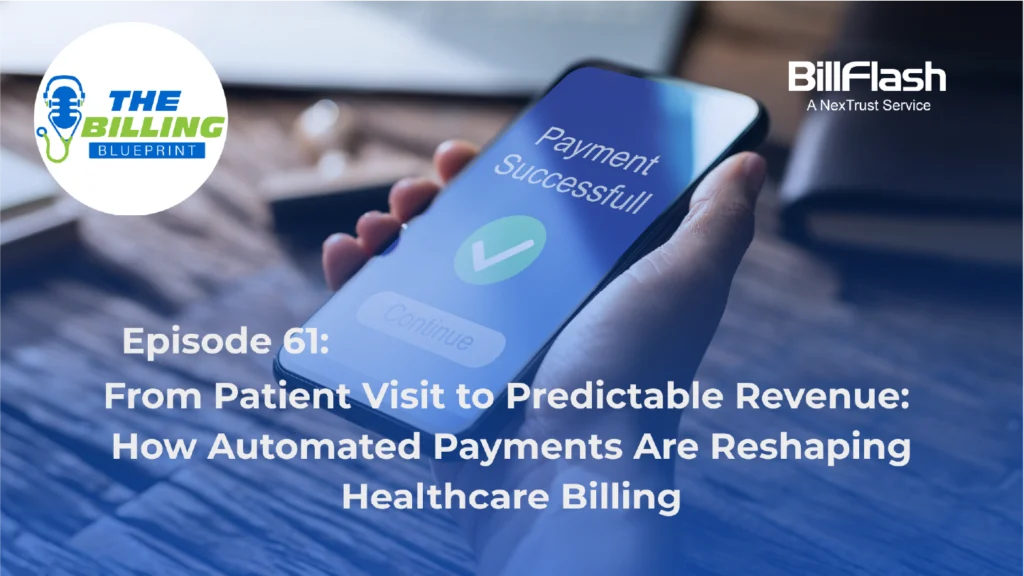
In this episode, we break down what really happens after a patient visit ends—and why collecting payment has become one of the biggest challenges in modern healthcare. With the rise of high-deductible health plans, practices are no longer billing just insurance companies; they’re billing patients who expect the same convenience and flexibility they get from everyday consumer experiences.
We explore how outdated, manual billing processes create friction, delay payments, and overwhelm staff. We dive deep into automatic payment programs and explain how tools like autopay, payment plans, third-party financing, and health spending cards can transform patient billing from a stressful, reactive process into a proactive, predictable revenue strategy.
You’ll learn how flexible payment options reduce patient avoidance, shorten accounts receivable days, free up staff time, and improve the overall patient experience—while helping practices secure cash flow without relying on costly collections. This episode lays out a modern “payment toolbox” and shows why automation isn’t just about getting paid faster, but about building a healthier financial future for your practice.
Transcript
Narrator: 00:00
Welcome to the Billing Blueprint Podcast, your go to resource for innovative medical billing solutions. Each episode we explore the latest industry trends and share proven strategies to help your practice streamline operations and get paid faster. Now here are your hosts, Brad and Sarah.
Sarah: 00:21
Okay, let's unpack this. We're talking about that moment, you know, the moment a patient visit ends. For most healthcare practices, that's not the end of the story. It's. It's actually the beginning of a really long, costly, and uncertain process.
Brad: 00:35
Collecting the payment.
Sarah: 00:36
Exactly. Collecting the payment.
Brad: 00:37
And that uncertainty that is really the defining challenge for the business side of modern medicine. What's driven this massive shift is the rise of high deductible health plans. HDHPs. Right. Ten years ago, the patient might have owed, what, a $20 copay, easy. But today, because of these plans, a huge, often surprising chunk of the practice's revenue comes straight from the patient.
Sarah: 01:02
And we're talking thousands of dollars sometimes.
Brad: 01:04
Absolutely. So the practice isn't just dealing with a few big insurance companies anymore. Now they're dealing with hundreds, maybe thousands of individual consumers.
Sarah: 01:13
And those consumers have very different expectations.
Brad: 01:15
Precisely. The sources we looked at describe this perfectly. It's turned medical billing into a, quote, consumer retail experience. Patients today are consumers first.
Sarah: 01:25
They're used to one click ordering on Amazon, streaming, Netflix, all of it.
Brad: 01:29
They expect that same ease, that flexibility and transparency with any bill they have to pay.
Sarah: 01:34
But instead they get this old, inflexible process. A paper statement that shows up 60 days late and makes no sense.
Brad: 01:43
And that friction is exactly what causes them to delay or just ignore the payment completely.
Sarah: 01:47
Which is the core problem we're going to tackle. Our mission today is a deep dive into automatic payment programs. We want to understand how they work, why they're so vital for a modern practice, and the specific tools that can.
Brad: 02:00
Solve this friction problem and how they can secure predictable revenue while cutting down on all that administrative work.
Sarah: 02:07
Let's start with the before picture. The inefficient cycle practices are so desperate to get away from. It's just so manual and slow.
Brad: 02:15
It's a bureaucratic marathon. I mean, the patient leaves and the clock starts ticking while the staff just waits.
Sarah: 02:21
Waits for what?
Brad: 02:21
For the insurance adjudication?
Sarah: 02:23
Yeah.
Brad: 02:23
That alone can take weeks. Only after that can the billing team even calculate what the patient actually owes.
Sarah: 02:29
And then comes the part that seems, I mean, just crazy in a digital age.
Brad: 02:33
Right? They have to generate the statement, physically.
Sarah: 02:36
Print it, fold it, stuff it in an envelope, meter it, and mail it. And this happens every Single month for every single outstanding balance.
Brad: 02:45
And then you wait again. The patient gets the bill. Maybe they open it, maybe they lose it, or maybe they call the office with a question, which takes up more staff time.
Sarah: 02:54
So the whole cycle just repeats. It's no wonder revenue cycles are measured in days or even weeks, not hours.
Brad: 03:00
Definitely not hours.
Sarah: 03:02
Okay, so let's introduce the solution here. At the heart of it is the automatic payment program, or autopay. How does that. I mean, how does it completely disrupt that manual cycle?
Brad: 03:12
Well, the basic idea is a service that lets a merchant, in this case the provider, automatically pull funds from an account the patient has authorized.
Sarah: 03:21
Like our utility bills or a gym membership. We know this model exactly.
Brad: 03:25
But applying it to the, you know, the variable world of medical billing, that's where the innovation is.
Sarah: 03:32
So how does it work there in healthcare?
Brad: 03:34
It's used to securely capture payment information right up front or to set up recurring payment schedules that just run on their own. No human intervention needed after that initial setup.
Sarah: 03:44
And that just eliminates the most painful parts of the back office workflow completely.
Brad: 03:48
And you can see the benefits right away. They're quantifiable.
Sarah: 03:50
The first big one has to be just reducing the administrative workload.
Brad: 03:54
Absolutely. Staff members who are spending 10, 15 hours a week printing statements and making collection calls are suddenly freed up.
Sarah: 04:02
So you're moving your team from just doing admin work to something that actually generates value.
Brad: 04:06
Exactly. And second, and this is probably the most important thing for the cfo, you drastically cut your AR accounts receivable days.
Sarah: 04:16
Basically how long it takes to get paid.
Brad: 04:18
Right. And the goal is always to shrink that number by getting a digital payment agreement up front. The money moves instantly on the agreed upon date. There's no lag from printing, mailing, waiting for a check. None of it.
Sarah: 04:31
Okay, so automation drives efficiency. That makes sense. But let's connect it back to the patient to that avoidance problem.
Brad: 04:37
Yeah, this is where it gets really fascinating. We tend to assume non payment is, you know, intentional, but it's usually born out of real financial stress.
Sarah: 04:46
It's panic.
Brad: 04:47
It's panic. One of the sources cited a study that found nearly 40% of Americans would struggle to pay a $400 emergency expense. So when a 500 or $1,000 medical bill shows up out of the blue, they.
Sarah: 05:00
They just shut down. Avoidance.
Brad: 05:03
Yes. If a practice sends a bill demanding the full thousand dollars right now and the patient just can't do it, what do they do? They pay nothing. They ignore the bills, hoping they can figure it out later.
Sarah: 05:15
And that's what leads to collections, which hurts everyone.
Brad: 05:17
Right? So flexibility isn't just a nice thing to have. It is the strategic tool you use to fight that avoidance behavior.
Sarah: 05:25
It really reframes the role of the billing department, doesn't it? They're not just debt collectors anymore.
Brad: 05:29
They're more like financial counselors. When patients see options, when they feel in control, they trust you more. A patient who sees an option to pay, say, $50 a month is way more likely to engage immediately.
Sarah: 05:41
And for the practice, the payoff is huge. It's predictable revenue.
Brad: 05:45
You're not just hoping for a big check that might never come. You're getting a consistent stream of smaller payments you can actually rely on for your operating costs. You're turning bad debt into structured cash flow.
Sarah: 05:57
But to get there, you can't just have one solution, can you? You need a whole toolbox. Because your patients are all in different financial situations.
Brad: 06:05
That's the key. You need a full automated toolbox. Let's dive into the four distinct types.
Sarah: 06:11
Okay, let's start with the simplest one, the one we mentioned earlier. Autopay.
Brad: 06:15
This is your classic set it and forget it model. It's perfect for patients who have those recurring predictable charges like chronic care management.
Sarah: 06:23
Or maybe orthodontic adjustments, things like that.
Brad: 06:26
Exactly. The patient authorizes the practice to charge their card on file. After insurance pays its part, the practice gets paid instantly, no chasing required.
Sarah: 06:36
And for the patient, it's just pure convenience. No remembering to pay, no late fees. It's a low effort solution for low friction payments.
Brad: 06:44
Right. But now let's level up to plan pay. This is for those moderate balances, the.
Sarah: 06:49
Ones that are too big to pay all at once, but maybe not big enough for a full loan. That surprise $600 lab bill.
Brad: 06:57
The panic bill. Exactly. Plan pay lets the patient go to a secure online portal. And this is the key. Customize their own payment terms. They can pick the date that works for their paycheck, choose an amount they can actually afford each month.
Sarah: 07:10
So it puts them in control.
Brad: 07:12
It does. But. And this is so important for the provider, the practice still maintains financial control. They set the rules.
Sarah: 07:19
What kind of rules?
Brad: 07:20
You can set a minimum monthly payment, say $50, so people aren't paying $5 a month forever. You can set a minimum bill amount for a plan to be, and you can set a maximum duration, like 12 months.
Sarah: 07:31
So there are guardrails. That's key. But what if the balance is really big? That brings us to flexpay for things like a $5,000 surgery FlexPay is a.
Brad: 07:41
Strategic game changer because it transfers all the risk. The patient applies for third party financing, but the practice gets the full payment upfront, usually within one business day.
Sarah: 07:51
Wait, okay. If the patient defaults on that loan later on, is the practice on the hook for that?
Brad: 07:57
Zero. Absolutely no recourse against the practice. The financing company takes on all of that risk and handles any collections.
Sarah: 08:05
Wow, that is a huge difference compared to traditional collections agencies.
Brad: 08:09
It's night and day. A collection agency might keep 25 to 50% of whatever they recover, if they recover anything. With Flexpay, you get nearly the full value right away.
Sarah: 08:19
And what's the experience like for the patient?
Brad: 08:22
It's fast. The applications online takes less than a minute. Approval rates are really high. The sources say around 90%. And it's often done without a hard credit check.
Sarah: 08:31
And they get good terms?
Brad: 08:32
Yes. There's usually a big incentive, like a 0% interest option for three or even six months. It makes saying yes to necessary treatment much, much easier.
Sarah: 08:41
That makes sense. By offering the option, the practice is seen as helping enable the care, not just demanding money.
Brad: 08:47
It becomes a consultative relationship, not a contentious one.
Sarah: 08:50
Okay, finally, let's talk about the fourth tool, the modern health spending card. The example in the sources was the Pay Woot Health spending card.
Brad: 08:59
Right. Think of this as a digital wallet just for health care. It's for patients who want to budget for their health expenses and keep that money separate from, you know, their grocery money.
Sarah: 09:12
So what makes it better than just using a regular Visa card?
Brad: 09:15
It's the terms and the convenience. It's accepted everywhere Visa is, so it covers prescriptions, dental, vision, everything. And the financing terms are designed for healthcare, such as they often have great promotional periods. For example, 0% interest for four months on all healthcare costs. And that can extend up to 12 months for bigger hospital bills.
Sarah: 09:34
So it's essentially an interest free loan if you pay it off in that window.
Brad: 09:38
Correct. And it's convenient. You can add it to your Apple Pay or Google Pay. The patient can just tap to pay at the front desk. It just removes another layer of friction.
Sarah: 09:45
Okay, so we have four distinct tools. Autopay Plan, Pay, Flex Pay, and the Health Spending Card. Why do you need all of them? Why not just pick one?
Brad: 09:54
Because your patients aren't all the same. One person might owe $40 and the next person owes 4,000. You need a system that can intelligently offer the right tool for the right situation.
Sarah: 10:06
The sources had some great scenarios for this, like the mom with two kids who comes in for flu shots. Total copay is 40 bucks.
Brad: 10:13
For her, it's autopay. She set it up ages ago. The charge is processed, she gets a receipt. She never even thinks about it.
Sarah: 10:20
Done. Then you have the professional who gets that unexpected $600 MRI bill.
Brad: 10:25
She can't pay at all this month, so she uses plan Pay, sets up 3 month plan for 200amonth. Right after her paycheck hits. The debt is secured instantly.
Sarah: 10:35
Perfect. Then there's the patient who needs a $4,000 surgery but doesn't have the cash.
Brad: 10:40
Uses Flexpay, gets instant financing. The practice gets its $4,000 the next day and schedules the surgery. The patient gets the care they need.
Sarah: 10:49
And finally, the patient with a $1,500 deductible to meet. Right. They don't have it in their checking account, so they apply for the Paywood Health spending card on their phone in the waiting room, get approved, and pay with the virtual card right on the spot.
Brad: 11:03
So using the whole toolbox just maximizes your chances of getting paid by. By removing every possible barrier.
Sarah: 11:10
And that raises an important question. If we connect this back to the big picture. What happens when your staff gets those 10 hours a week back? The time they were spending on manual billing?
Brad: 11:20
That time isn't just saved, it's reallocated. Right?
Sarah: 11:23
Exactly. They can focus on high value work. Improving the schedule, managing referrals, delivering better patient service. Things that actually grow the practice instead of just chasing old debt.
Brad: 11:34
So it's a total shift in strategy from aggressive lower turn collections to proactive automated financial management.
Sarah: 11:41
And it means health care billing doesn't have to be this stressful, awful thing for everyone. By using these programs, practices are investing in a better patient experience, One that respects their financial situation, while securing the practice's own cash flow.
Brad: 11:55
It really is a genuine win win. Yeah. And you know, knowledge is most valuable when you actually apply it. Think about how much a practice loses when a payment ages past 90 days. The data is clear. Automation means you get paid faster and you retain nearly the full value of.
Sarah: 12:11
That money instead of just writing it off or losing a huge chunk to a collection agency.
Brad: 12:16
Right. So this raises a final important question for anyone listening who manages a practice? How much hidden cost in staff, time in materials? In lost principle? How much does just waiting to get paid really add to your bottom line every month?
Sarah: 12:30
And what could your staff accomplish? What growth could you achieve with all that time back?
Brad: 12:34
That is the strategic decision facing modern healthcare practices right now.
Narrator: 12:39
Thanks for tuning into the Billing Blueprint podcast. For more insights or to dive deeper dive deeper into today's topics. Head over to billflash.com. Don't forget to subscribe and we'll catch you next week with more strategies to keep your practice running smoothly and getting paid faster
Sources:
Automatic Payment Programs — Giving Patients Billing Flexibility While Speeding Up Your Cash Flow