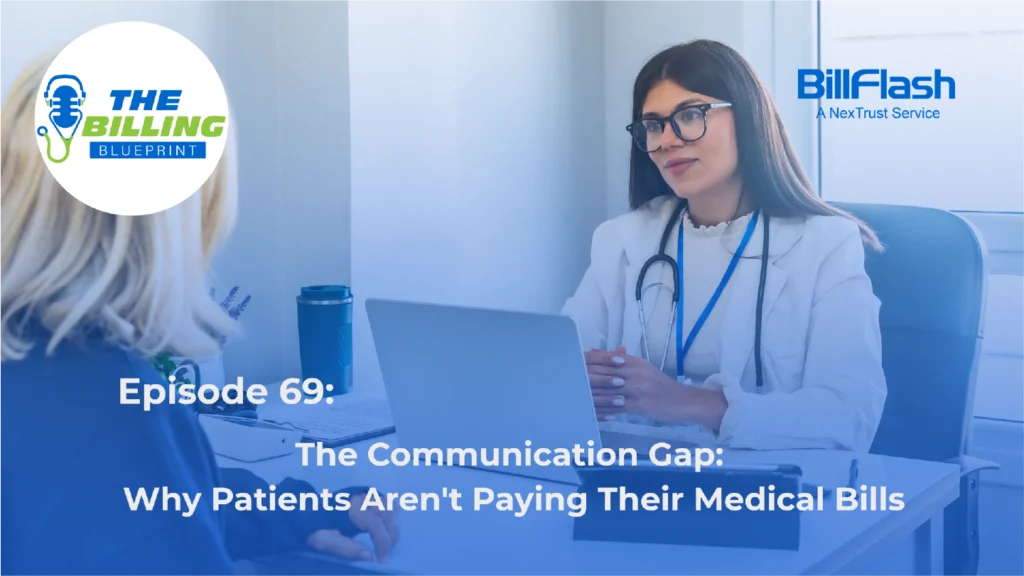
Medical billing is one of the most frustrating experiences patients face—and it’s quietly creating a massive problem for healthcare practices.
In this episode of The Billing Blueprint Podcast, we explore why so many patients struggle to understand their medical bills and how a deep communication gap between practices and patients is driving delayed payments, rising bad debt, and overwhelmed billing teams.
Research shows that nearly 80% of medical bills contain errors, only 22% of patients know what they owe before receiving care, and 36% of U.S. households carry medical debt. But the issue isn’t simply that patients refuse to pay. More often, patients are confused by a fragmented billing process involving multiple systems, conflicting messages, and unclear payment instructions.
We break down how practices can address this challenge by implementing connected patient communication platforms that bring together mail, text, email, and payment portals into one unified experience. From pre-visit billing estimates to QR codes on paper statements, automated payment reminders, and two-way messaging, the episode explores how removing friction from billing communication helps practices collect payments faster while improving patient trust.
Tune in to learn how better communication can transform the patient billing experience—and the financial health of your practice.
Transcript
Narrator: 00:00
Welcome to the Billing Blueprint Podcast, your go to resource for innovative medical billing solutions. Each episode we explore the latest industry trends and share proven strategies to help your practice streamline operations and get paid faster. Now here are your hosts, Brad and Sarah.
Sarah
00:21
Picture the scenario. You just got home from a really long day.
Brad
00:27
We all know the feeling, right?
Sarah
00:28
You check the mail and there it is. That distinct, heavily windowed envelope from a doctor's office or a hospital.
Brad
00:36
Just seeing it kind of ruins your evening a little bit.
Sarah
00:38
It really does. So you open it up and instead of a clear invoice, you're staring at this. Well, it's basically a grid of numbers. Right. Obscure alphanumeric codes.
Brad
00:50
Yeah. Completely indecipherable to the average person.
Sarah
00:52
Exactly. And a balance due that seems completely detached from the copay you thought you already saw settled at the front desk.
Brad
00:58
You're just scratching your head.
Sarah
01:00
And the actual instructions on how to pay it, they're buried at the bottom in tiny print, pointing you to a website that looks like it hasn't been updated since, I don't know, 2004.
Brad
01:10
If the link even works at all.
Sarah
01:11
Right. We have all been there. It is a universally frustrating, often panic inducing experience.
Brad
01:17
It is because it creates an immediate, heavy cognitive load for the patient. You're holding this piece of paper, trying to reverse engineer the entire billing process from scratch. You're wondering, did my insurance actually process this claim? Was the network status of the provider correct, or should I just put this bill in a drawer for a week until I have the mental energy to call the billing department?
Sarah
01:40
Which you'd have to do on your lunch break, of course.
Brad
01:42
Exactly. For what should ideally be a simple, straightforward financial transaction, the friction is just incredibly high.
Sarah
01:50
That shared friction is what brings us today's source material. For all of you listening, we are diving into a really comprehensive analysis from BillFlash. It's titled Patient Communication Platforms and How They Impact Engagement.
Brad
02:03
It's a great piece.
Sarah
02:04
It really is. So our mission for this deep dive is to uncover the hidden administrative bottlenecks that are quietly driving a massive portion of the medical debt crisis. We are going to explore how something as seemingly mundane as a unified communication platform can drastically change the financial health of both patients and, meaning you, the learner, and the medical practices themselves.
Brad
02:27
It's a bigger deal than people realize.
Sarah
02:29
It really is. Okay, let's untack this because the underlying data here exposes a system that is functioning far below the standards we accept in almost any other industry.
Brad
02:40
Yeah. When you look at the raw statistics driving medical billing today, you realize very quickly that the system isn't just inefficient. It's actively working against both the provider and the patient.
Sarah
02:51
How bad is it exactly?
Brad
02:52
Well, according to the data highlighted in our source, almost 80% of medical bills contain mistakes.
Sarah
02:58
80%?
Brad
03:00
Yes. Eight out of 10 bills have an error somewhere, whether it's in the coding, the routing, or the final balance.
Sarah
03:07
I mean, I genuinely cannot think of another sector where an 80% error rate is just absorbed as a cost of doing business.
Brad
03:15
There isn't one.
Sarah
03:15
Right. If 80% of your grocery receipts charged you for items you didn't buy or applied the wrong tax rate, you'd immediately stop shopping at that store.
Brad
03:23
You'd demand to see a manager every single time.
Sarah
03:26
Exactly. But in healthcare, the system is so opaque that patients rarely even know how to spot the mistake, let alone contest it. And the ripple effects of that opacity are really severe. The article notes that in 2024, 36% of U.S. households carried medical debt.
Brad
03:43
That is a staggering number of households.
Sarah
03:45
It is. Furthermore, a commonwealth funds survey cited in the text showed that 45% of insured working age adults received unexpected bills.
Brad
03:54
Wow.
Sarah
03:55
Yeah. These are people who did everything right. They bought insurance, they stayed in-network, and they are still getting hit with surprise costs.
Brad
04:02
And this brings us to a pervasive misconception in healthcare finance that we really need to dismantle today.
Sarah
04:08
Okay, what is that?
Brad
04:09
There is an assumption, often built into legacy collection strategies, that medical debt accumulates primarily because patients are simply refusing to pay their obligations.
Sarah
04:18
Like they just don't want to pay.
Brad
04:19
Right. But the data shows that narrative is largely a myth. Medical debt happens in large part because of a deeply confusing, entirely disconnected billing process. It is rarely a lack of willingness to pay.
Sarah
04:32
So it's an information problem.
Brad
04:34
Exactly. Most of the time, it is a catastrophic lack of clarity.
Sarah
04:38
The clarity deficit is staggering. The source points out that only 22% of patients actually know what they owe before they receive care.
Brad
04:47
Just 22%.
Sarah
04:48
Think about that in the context of any other professional service. You wouldn't hire a contractor to renovate your kitchen without a detailed estimate.
Brad
04:57
Never.
Sarah
04:57
Or hand a mechanic your car keys without knowing the diagnostic fee. But in healthcare, nearly 80% of consumers are flying entirely blind.
Brad
05:07
Yeah. And when that confusing bill finally does arrive, and it inevitably contains one of those errors we just mentioned, the source notes it can take an extra 40 days just to resolve that single mistake.
Sarah
05:18
An entire month?
Brad
05:19
Yes. What's fascinating here is how the internal tools utilized by Medical practices actually compound this confusion rather than alleviate it.
Sarah
05:27
How so?
Brad
05:28
Well, from a technological standpoint, many practices have built a highly fragmented communication stack over the years. They might have a legacy system for generating and mailing paper statements.
Sarah
05:39
Okay, that's one system.
Brad
05:40
Right. Then they adopted an entirely different software module for their digital patient portal system number two. Later, they bolted on a third party application just to send SMS text reminders. And they probably use a completely separate payment gateway for processing credit cards online.
Sarah
05:57
That's four different platforms.
Brad
05:59
Exactly. For you, the patient on the receiving end. This backend fragmentation manifests as an absolute maze of mixed messaging.
Sarah
06:07
You essentially have four different digital voices speaking to you about the exact same problem. And they rarely sync up.
Brad
06:13
They almost never sync up.
Sarah
06:15
But surely from a business operations perspective, the hospital or the private practice doesn't want you to be confused. They want to collect their revenue. So why hasn't this been standardized?
Brad
06:25
It comes down to how these practices scaled their technology over time. They adopted localized solutions for isolated problems over a decade rather than building a holistic communication architecture from the ground up.
Sarah
06:37
putting band aids on things.
Brad
06:39
Exactly. And the result is that patients become paralyzed by the barrage of disjointed information. They might receive an automated text message on Tuesday saying they owe a certain amount.
Sarah
06:52
Right.
Brad
06:52
On Thursday, a piece of physical mail arrives with a slightly different amount because it was printed three days prior to a MUD or insurance adjustment.
Sarah
07:01
So now the patient is sitting there looking at two different numbers.
Brad
07:04
Yes. And the patient is left wondering which number is accurate. Did their insurance actually pay their portion, or was that text just a phishing scam?
Sarah
07:12
Oh, that's a huge fear now with text messages.
Brad
07:15
Absolutely. When consumers face that level of uncertainty, their default behavior is to disengage. They delay payment because they are terrified of paying the wrong amount and never seeing that money again.
Sarah
07:27
Let's shift the lens for a moment and look at the provider side of this equation. Because it is very easy for us as consumers to point fingers at the billing department.
Brad
07:35
It is.
Sarah
07:35
But this fragmented tech stack is completely gutting the efficiency of healthcare workers.
Brad
07:40
Oh, it's terrible for the staff. Imagine the daily workflow of a medical billing specialist operating within the unorganized platforms we just described. Their entire morning consists of acting as a human API integration.
Sarah
07:54
A human API. I love that term, but it sounds exhausting.
Brad
07:58
It is. They are logging into the electronic medical record system, cross referencing that with the separate payment gateway to see if an online transaction cleared, then checking a third dashboard to see if an SMS reminder
Sarah
08:11
Was sent just constantly tabbing between windows.
Brad
08:14
And then they spend hours playing phone tag with understandably frustrated patients who are calling in to ask why their online portal shows a different balance than the paper statement sitting on their kitchen counter.
Sarah
08:25
Which isn't the staff's fault, but they have to deal with the angry caller.
Brad
08:28
Exactly. The source explicitly highlights that these types of billing disputes and inquiries are currently the single biggest administrative challenge facing medical practices today.
Sarah
08:38
And as anyone who understands business finance knows, administrative friction of that magnitude eventually bleeds directly into the bottom line. The learner audience will recognize that in an era where consumer fintech allows for instantaneous one click checkouts, everywhere else, health care metrics are inexplicably trending in the opposite direction. The data in the source is stark.
Brad
09:01
It really is.
Sarah
09:02
Between 2023 and 2024, patient bad debt rose by 14%. At the same time, near the end of 2024, average accounts receivable days increased by 2.2%.
Brad
09:15
If we connect this to the bigger picture, an increase in AR days and a 14% spike in bad debt within a single year is a massive red flag for the financial stability of the healthcare sector.
Sarah
09:26
It's totally unsustainable.
Brad
09:28
Completely. The recognized benchmark for top performing medical practices is to maintain their accounts receivable below 40 days.
Sarah
09:35
40 days, right.
Brad
09:36
But achieving that metric is virtually impossible when your staff is bogged down answering basic preventable questions. Every hour a billing clerk spends manually tracking down a lost check or explaining a discrepancy between a text and a letter is an hour they aren't spending on proactive revenue cycle management.
Sarah
09:53
The staff is buried in the noise. And when they are buried, those unpaid balances quietly age. They cross the 40 day threshold, then the 60 day than the 90 day until they eventually age into uncollectible territory,
Brad
10:05
Forcing the business to take a massive write off.
Sarah
10:08
The bad communication tools are literally draining the cash flow.
Brad
10:11
That is the vicious cycle. But the source outlines a structural pivot that can reverse this trend. Which brings us to the concept of omnichannel consistency. Centralizing the communication architecture is the only sustainable way out of this bottleneck.
Sarah
10:29
There is a metric in this BillFlash analysis that honestly stopped me in my tracks.
Brad
10:33
Which one?
Sarah
10:34
They found that practices that successfully combine email, SMS, text and traditional paper mail into one single cohesive billing platform can reduce their average time to payment from 20 days down to just nine days-
Brad
10:46
Cutting the collection cycle by 11 days. That represents more than a 50% improvement in payment velocity.
Sarah
10:52
By organizing their communication.
Brad
10:55
Exactly. And the crucial takeaway is that this acceleration isn't achieved by deploying more aggressive collection tactics.
Sarah
11:01
Right. They aren't hiring an army of debt collectors.
Brad
11:03
No, it is achieved entirely by removing the friction and meeting patients where they are with a consistent message.
Sarah
11:10
Meeting patients where they are? That's a phrase we hear a lot in business. But the data on patient preferences in this article presents a fascinating contradiction.
Brad
11:19
It really does.
Sarah
11:20
The breakdown looks like 62% of healthcare consumers prefer to actually execute their payments online. That makes total sense in today's digital economy. Sure, but 74% of consumers still state a strong preference for receiving their initial medical bill via physical mail.
Brad
11:38
Right?
Sarah
11:39
On top of that, 51% admit that receiving an sms text message would prompt them to pay that bill faster.
Brad
11:46
It looks like a paradox. On paper.
Sarah
11:48
Yeah.
Brad
11:48
You have an audience that demands a physical document, prefers a digital checkout, and requires a mobile nudge to take action.
Sarah
11:54
How do you even reconcile that as a practice manager?
Brad
11:57
Well, you cannot simply pick the most efficient channel for the business and force the patient to adapt. If you go fully digital, you alienate the 74% who rely on the mail.
Sarah
12:09
Yeah.
Brad
12:09
If you stick only to paper, you frustrate the 62% who want to pay with Apple Pay or a credit card online. A centralized omnichannel strategy bridges all three mediums simultaneously.
Sarah
12:22
Here's where it gets really interesting. How does a practice actually pull this off without requiring their staff to triple their workload?
Brad
12:31
That's the million dollar question.
Sarah
12:32
Because manually orchestrating a synchronized letter, email and text message for every single patient sounds like a logistical nightmare.
Brad
12:40
It would be, which is why the integration of the software is the differentiator. The source uses the BillFlash platform as the prime case study for how this architecture functions in practice. Let's trace the patient journey chronologically through these touch points to see how the friction is systematically removed, starting with the Pre-Visit phase.
Sarah
12:58
Okay. The Pre-Visit.
Brad
12:59
We established earlier that the primary catalyst for delayed payment is Surprise. BillFlash utilizes a module called PreBill to address the financial expectation before the patient ever arrives at the clinic.
Sarah
13:11
I want to dig into that Pre-Visit phase. How do you effectively secure a financial commitment before the doctor has even performed an examination or finalized the diagnostic codes?
Brad
13:23
You provide a clear, secure estimate, based on the scheduled service. Before the appointment, the centralized system automatically generates and sends a secure link via email or text.
Sarah
13:33
Okay.
Brad
13:34
That link directs the patient to a dedicated payment portal. The source mentions Paywoot.com as the gateway. And there the patient can view a breakdown of their expected out-of-pocket costs.
Sarah
13:45
So they see the math up front.
Brad
13:46
Yes, they see exactly what their responsibility will be, factoring in their known insurance coverage for that specific visit type.
Sarah
13:52
It effectively acts as a digital anchor. The patient goes into the waiting room knowing they owe $50 or $500. It fundamentally alters the psychology of the appointment.
Brad
14:01
It totally does.
Sarah
14:02
The patient isn't sitting on the examination table silently agonizing over a hidden fee, and they have the opportunity to arrange financing or ask questions before the service is rendered. The financial momentum is established early.
Brad
14:15
Precisely. It sets a transparent baseline. Now, after the visit occurs and the final claim is adjudicated by insurance, we move into the actual billing phase. Here's where we have to solve that paradox we discussed earlier.
Sarah
14:27
The 74% who want paper versus the 62% who want to pay online.
Brad
14:32
Right. The source highlights a brilliant yet incredibly simple technological bridge for this- the strategic use of custom QR codes printed directly on the mailed statements.
Sarah
14:41
I love this concept because it solves such a stubborn behavioral hurdle. Traditional paper bills are completely static. When you receive one, you are forced into a multi-step manual process.
Brad
14:52
A very tedious process.
Sarah
14:53
Yeah. You have to hunt down your checkbook, find a stamp and walk to a mailbox. Or you have to sit at your computer and manually type a 40 character case sensitive URL into your browser, which almost always results in a typo and a frustrating error screen.
Brad
15:07
And every single one of those manual steps represents an opportunity for the patient to abandon the process and leave the bill unpaid.
Sarah
15:15
Exactly.
Brad
15:16
By embedding a custom patient specific QR code on the physical document, you instantly convert a static piece of paper into a dynamic actionable link.
Sarah
15:26
It bridges the gap perfectly.
Brad
15:28
It does. The patient opens the envelope, reviews the familiar trusted paper document. Then they pull out their smartphone and scan the code. They bypass the login screens and the URL typing entirely, landing directly on their specific balance page on Paywhoot.com, ready for a one click payment.
Sarah
15:44
It perfectly satisfies the psychological need for official physical mail while delivering the frictionless transaction speed of E-commerce.
Brad
15:52
It honors the legacy preference without sacrificing modern efficiency.
Sarah
15:55
So for the segment of the patient population that prefers fully digital communication, how does the centralized system handle the follow up without turning into annoying spam?
Brad
16:05
The platform manages digital follow up through automated eBills and PayReminders. An e-Bill is dispatched as a same day email or text notification containing that same secure payment link. It strikes while the iron is hot, often reaching the patient before they have even driven home from the clinic. But the True operational value for the medical practice lies in the logic governing the PayReminders.
Sarah
16:29
Because asking a stretched thin billing team to manually track hundreds of accounts and send individual follow up texts is exactly what causes the staff burnout we discussed earlier.
Brad
16:39
Right. A centralized platform handles this autonomously. The software is programmed to send a sequence of scheduled texts and emails to patients with outstanding balances. However, the critical piece of intelligence built into this omnichannel system is that it operates on a single source of truth.
Sarah
16:55
A single source of truth- Meaning everything is synced.
Brad
16:57
Exactly the moment a payment is processed. Whether the patient mailed a physical check that the staff scanned in or they paid via the QR code on their phone, the automated reminders instantly cease.
Sarah
17:09
That real time syncing is vital. From a consumer standpoint, there are few things more aggravating than paying a substantial medical bill on a Tuesday only to receive a bold, urgent text message on Thursday demanding payment for that exact same invoice. It is so frustrating, it instantly destroys your trust in the provider's competence. You start wondering if your payment was lost in the digital ether. Smart automation prevents that brand damage.
Brad
17:35
It restores a sense of professionalism to the entire revenue cycle. Which brings us to the final and perhaps most crucial touch point detailed in the bill flash analysis. Opening a genuine dialogue.
Sarah
17:46
Right, because things go wrong.
Brad
17:48
Even with crystal clear estimates and frictionless QR codes, healthcare is complex. Patients will inevitably have questions. They might want to dispute a specific line item code, query why their secondary insurance wasn't applied, or proactively request a structured payment plan for a high deductible balance.
Sarah
18:04
Historically, initiating that dialogue required the patient to clear their schedule, call a 1-800-number during narrow business hours, navigate a convoluted phone tree, and sit on hold listening to elevator music for 30 minutes.
Brad
18:17
Just to ask one question.
Sarah
18:18
Yeah. That friction is exactly why people adopt the set it aside mentality and let the account age into bad debt.
Brad
18:24
The BillFlash platform dismantles that barrier by enabling asynchronous two-way communication. Patients can reply directly to the SMS text messages or the emails they receive, or they can initiate a secure chat directly through the PayWoot portal. The communication routes directly to the billing staff's centralized dashboard.
Sarah
18:44
That changes the dynamic entirely. The patient isn't fighting a bureaucracy. They are just sending a quick digital inquiry. Exactly as they would with a modern software subscription or an airline. The barrier to getting an answer drops to near zero. Yes, you send a text asking about the insurance adjustment. The staff replies with clarification. A few hours later, your concern is resolved and you execute the payment.
Brad
19:04
When you evaluate all these touch points in unison, the PreBill estimates setting expectations, the QR codes bridging the physical digital divide, the intelligent automation preventing redundant follow ups, and the asynchronous two way messaging, the cumulative impact of a singular platform becomes obvious. It's night and day for the administrative staff. They finally have complete unfragmented visibility. They can pull up a patient's ledger and instantly see the entire communication history across every channel. There is no guesswork, no logging into four different portals, and no conflicting information.
Sarah
19:41
So what does this all mean? If we synthesize everything we have covered today? The core revelation is that simplifying communications systematically removes the friction of healthcare billing. When you strip away the technological maze and present a clear, unified message, patients regain their trust in the process.
Brad
19:57
That trust is everything.
Sarah
19:59
And when patients trust the process and actually understand their financial obligations, practices get paid faster, write offs plummet and medical staff get their valuable time back to focus on actual healthcare rather than acting as full time debt collectors.
Brad
20:11
It represents a profound shift away from the traditional adversarial relationship where patients feel financially ambushed and practices feel ignored. By prioritizing clear omnichannel engagement, the industry can reduce those AR days, curb the rise in bad debt, and introduce a level of predictability into a sector that desperately needs it.
Sarah
20:32
For you, the listener, the applications of this deep dive extend far beyond the walls of a hospital. Whether you are scaling a startup, managing client relations, designing user interfaces, or just someone dreading the arrival of your next medical invoice, the underlying business lesson is universal. Fragmented communication is the absolute enemy of action.
Brad
20:51
Well said.
Sarah
20:52
If you want your audience to engage to pay an invoice or to trust your brand, you have to meet them where they are with a singular, consistent and frictionless experience.
Brad
21:01
That is the essential takeaway for any operator.
Sarah
21:03
Thank you so much for joining us and exploring this complex, critical topic with us today. Until next time, keep learning and we'll catch you on the next deep dive.
Brad
21:12
Thanks for tuning in to the Billing Blueprint podcast. For more insights or to dive deeper into today's topics, head over to BillFlash.com. Don't forget to subscribe and we'll catch you next week with more strategies to keep your practice running smoothly and getting paid faster.
Narrator
21:32
Thanks for tuning into the Billing Blueprint podcast. For more insights or to dive deeper dive deeper into today's topics. Head over to billflash.com. Don't forget to subscribe and we'll catch you next week with more strategies to keep your practice running smoothly and getting paid faster
Sources:
How Patient Communication Platforms Improve Engagement at Every Billing Touchpoint