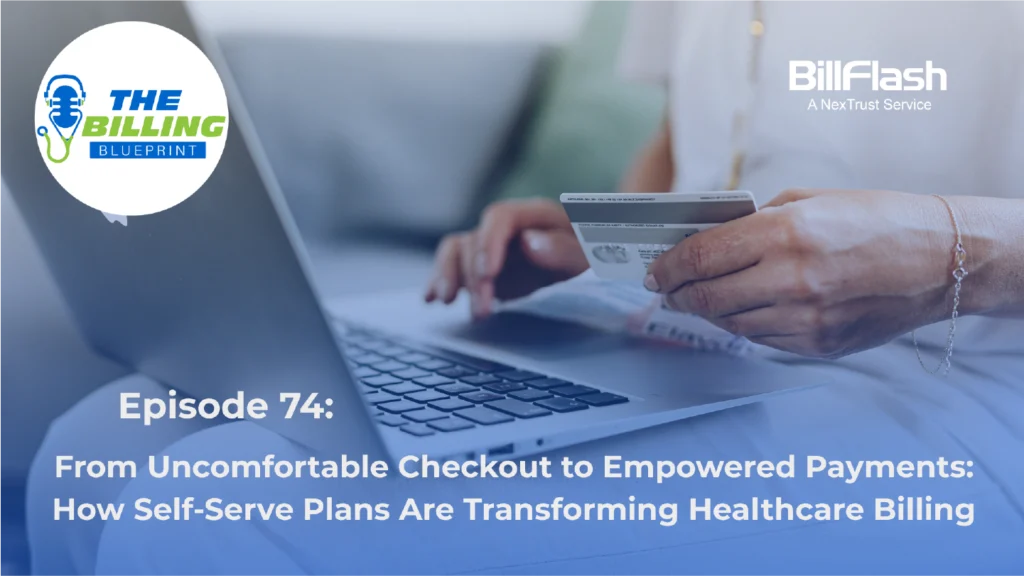
This episode explores the stressful, high-pressure moment patients face at the doctor’s office checkout—and how it’s being reimagined through self-serve payment technology. As rising out-of-pocket costs shift more financial responsibility onto patients, traditional billing methods are breaking down, creating friction for both patients and staff.
The hosts unpack how introducing digital, self-serve payment plans at checkout leverages a key psychological moment—the “care mode window”—when patients are most motivated to resolve their bills. By offering flexible, pre-approved payment options (like installment plans, third-party financing, and AutoPay), practices can reduce anxiety, improve collections, and eliminate the need for staff to act as debt collectors.
The discussion highlights how these systems balance patient flexibility with provider control through built-in guardrails, while also protecting cash flow and minimizing reliance on collections agencies. Ultimately, the episode frames this shift as part of a broader trend: healthcare catching up to modern consumer expectations by delivering transparent, convenient, and dignified financial experiences.
Transcript
Narrator: 00:00
Welcome to the Billing Blueprint Podcast, your go to resource for innovative medical billing solutions. Each episode we explore the latest industry trends and share proven strategies to help your practice streamline operations and get paid faster. Now here are your hosts, Brad and Sarah.
Sarah: 00:23
Picture this. You’re. You’re standing at the checkout desk of your doctor’s office.
Brad: 00:28
Oh, wow. I can already feel the anxiety.
Sarah: 00:31
Right. It’s universally uncomfortable. You’ve just finished your appointment. Maybe you’re a little tired or, you know, you’re still processing whatever the doctor just told you in the exam room.
Brad: 00:39
Yeah. You’re just trying to gather your things and get out of there.
Sarah: 00:41
Exactly. You are holding that familiar, slightly worn plastic clipboard. And then the person behind the desk looks at their monitor, they wince just a little bit, and they read you this unexpectedly high medical bill out loud.
Brad: 00:58
Right there in the middle of the waiting room.
Sarah: 00:59
We have all been there. Your stomach drops, the people sitting in the waiting chair suddenly seem like very quiet. And you’re basically put on the spot to make a major financial decision in about 10 seconds.
Brad: 01:13
It’s a uniquely high pressure environment. I mean, if you think about it’s this collision of healthcare, personal finance, and frankly, social anxiety.
Sarah: 01:21
Oh, absolutely.
Brad: 01:22
And it’s all happening over a laminated countertop while the phone is ringing in the background.
Sarah: 01:27
Yeah. That scenario is exactly the foundation of our mission for today’s deep dive. We are exploring a fundamental shift in the mechanics of healthcare billing.
Brad: 01:36
A very necessary shift, honestly.
Sarah: 01:39
Specifically, we’re looking at how introducing self-serve patient payment plans right at that checkout desk is completely transforming this notoriously.
Brad: 01:49
Tense moment, Taking it from that awful deer in the headlights experience to something much more streamlined.
Sarah: 01:54
Right. Like a retail interaction. And our insights today are pulled from a really comprehensive breakdown by BillFlash. It was published just recently in March 2026, and it’s titled The Benefits of a Self-Serve Patient Payment Plan at Checkout.
Brad: 02:08
And as we get into this, I want you to imagine the backdrop here changing to, like a sleek, modern medical office overlaid with digital data streams.
Sarah: 02:17
Ooh, I like that visual.
Brad: 02:19
Yeah. Because this deep dive isn’t just about reading a ledger or understanding accounting software. It’s really about the intersection of consumer psychology, healthcare, economics, and user experience.
Sarah: 02:29
Okay, let’s unpack this because I have to push back just a little bit right out of the gate.
Brad: 02:33
Sure, go ahead.
Sarah: 02:34
Hasn’t paying at the doctor literally always been a bit of a headache? I mean, nobody enjoys parting with their money.
Brad: 02:40
That’s fair.
Sarah: 02:41
So why is the bill Flasch analysis calling the checkout desk the most revealing moment in a healthcare practice right now. What makes today’s economic environment any different from, say, 10 or 15 years ago?
Brad: 02:56
Well, if we connect this to the bigger picture, we really have to understand that this is not a sudden overnight change.
Sarah: 03:02
Right.
Brad: 03:03
It’s more of a brewing storm that has finally made landfall. The analysis explicitly points to this massive structural shift in the healthcare industry, which is rising patient responsibility.
Sarah: 03:14
Meaning patients are on the hook for more.
Brad: 03:16
Exactly. We are talking about the proliferation of high-deductible health plans, highly complex coinsurance models, and just an increasing number of uncovered services.
Sarah: 03:25
Right. Because it used to be you walked in, you paid a flat $20 copay, and the insurance company handled the rest entirely behind the scenes. Yep.
Brad: 03:33
You didn’t even have to think about it.
Sarah: 03:34
The front desk was basically just collecting a toll. But now patients are functioning much more like primary payers.
Brad: 03:40
Precisely. The reality is patients are simply being asked to pay significantly more out of pocket today than they were just a few years ago.
Sarah: 03:49
And that has to cause a bottleneck.
Brad: 03:50
Oh, a massive one. That structural shift leads to immediate localized friction at the front desk when patients hesitate at checkout because they weren’t expecting a, you know, a massive four figure balance.
Sarah: 04:02
Which is terrifying.
Brad: 04:03
It is. And the entire operational flow of the staff just grinds to a halt. The research actually notes that asking a patient for a large payment without offering a concrete manageable plan, right then and there, it triggers a massive administrative cascade.
Sarah: 04:19
A cascade that essentially turns into a nightmare sequence for the clinic. I mean, I can see exactly how this chain reaction plays out.
Brad: 04:26
How so?
Sarah: 04:27
Well, the patient leaves without paying because they’re talking totally overwhelmed. So now the office is forced to print paper statements. They have to mail them out.
Brad: 04:34
Right. Buying postage, stuffing envelopes.
Sarah: 04:36
Yeah. And then they have to set up automated digital reminders. Then someone has to physically pick up the phone and start chasing down that balance.
Brad: 04:44
Which brings up a critical, undeniable fact highlighted in the breakdown. The source explicitly says front desk staff didn’t sign up to be collections specialists.
Sarah: 04:56
Man, that concept really hits hard. Imagine that in the context of your own job.
Brad: 05:00
It would be awful.
Sarah: 05:01
Like, imagine you applied for a role in hospitality or administration. Your goal is to welcome patients, help them get checked in, manage the schedule,
Brad: 05:09
Make them feel comfortable.
Sarah: 05:10
Exactly. And then suddenly, institutional shifts force you to spend half your day calling people at their homes, essentially acting as a debt collector, demanding money.
Brad: 05:20
That is just a recipe for instant burnout. And? And it completely fractures the patient provider relationship.
Sarah: 05:27
It has to.
Brad: 05:27
It’s uncomfortable for the staff and it’s highly alienating for the patient. You fundamentally do not want the person checking your vitals or asking about your symptoms to be the exact same person hounding you for a past due invoice.
Sarah: 05:39
That makes total sense. So the traditional method, you know, handing over a massive bill, watching the patient panic, and just hoping for the best through the mail, is systematically failing. It’s broken completely. Which forces the industry to look at the behavioral science side of things, specifically the psychology of when you ask for payment. Because in behavioral economics, timing is everything.
Brad: 06:03
Oh, absolutely. Timing is the whole game.
Sarah: 06:05
Think about it like buying furniture online. If you’ve got a beautiful, extremely expensive couch in your online cart, and that website didn’t offer a little button right there that said pay in four installments.
Brad: 06:17
You’d probably abandon the purchase.
Sarah: 06:18
Exactly. You’d just close the tab. Buy now, pay later is everywhere in the retail space. We just expect it. Why should healthcare be any different?
Brad: 06:25
What’s fascinating here is that the healthcare industry is finally engaging in this institutional catch up. They are looking at that consumer behavior and applying a specific psychological concept to the medical field.
Sarah: 06:38
Oh, what’s the concept?
Brad: 06:39
The source calls it the care mode window.
Sarah: 06:41
Care mode, okay. Contrast that with like normal consumer mode for me.
Brad: 06:46
So the care mode window is this very narrow timeframe where the patient is still highly engaged with the medical process itself.
Sarah: 06:53
Like when they are physically standing in the office.
Brad: 06:56
Right. Or when they’re actively logged into the secure patient portal, looking at their test results in this specific window, they are acutely aware of their balance and the.
Sarah: 07:07
Value of the care they just got.
Brad: 07:08
Exactly. They intimately understand that value, and most importantly, they are motivated to resolve it. In behavioral economics, this is the moment.
Sarah: 07:18
Of peak commitment, because the care is fresh in their mind. The doctor just looked them in the eye and helped them. The problem is solved. Or, you know, it’s actively being solved.
Brad: 07:25
Yeah, but the moment they leave that environment, the context completely shifts. The danger is entirely in the delay.
Sarah: 07:32
Because life happens.
Brad: 07:33
Exactly. The data shows that once a patient walks out that front door or once they click out of the portal, that urgency simply vanishes. They have to pick up their kids from school, go back to work, buy groceries.
Sarah: 07:44
The real world creeps back in.
Brad: 07:46
Yep. And the odds of collecting that full balance drop significantly as time passes. The source explicitly warns about this. If they look at a massive bill and decide they’ll just figure it out later when the paper statement arrives. Well, later almost always turns into never…
Sarah: 08:03
Which is exactly where the Self-Serve Patient Payment Plan steps in to bridge that gap.
Brad: 08:07
Right.
Sarah: 08:08
According to the bill flash breakdown, this is a customized installment plan that the patient sets up independently right at checkout. Or cleverly, it can even happen via a PreBill link sent through text or email before the appointment even starts.
Brad: 08:21
I love that feature. It’s so proactive.
Sarah: 08:23
It really is. It takes that incredibly awkward whispered, can I pay this later? Conversation and replaces it with clear digital private options. You aren’t negotiating with the receptionist.
Brad: 08:35
No, you’re just tapping the option on your phone that fits your monthly budget. It empowers the patient while they’re still in that highly motivated care mode.
Sarah: 08:42
Capitalizing on that peak commitment.
Brad: 08:44
Exactly. It removes the social friction and secures the revenue cycle for the practice before the patient ever leaves the building.
Sarah: 08:50
Okay, I understand the psychology, but here’s where it gets really interesting from an economic standpoint. Because if I am running a small medical practice and you tell me I am just handing over financial control to the patient to set up their own self-serve payment plan, I’m going to be sweating.
Brad: 09:08
Oh, for sure. It sounds risky, right?
Sarah: 09:10
If the patient is fully in charge and they owe me $2,000, what is stopping them from going into the app and saying, sure, I’ll pay $1 a month for the next two centuries?
Brad: 09:19
That would be a problem.
Sarah: 09:20
Or even more realistically, what if a small clinic with a massive payroll has all of its patients suddenly opt to pay their bills over 24 months? That clinic would go bankrupt waiting for the cash to trickle in.
Sarah: 09:29
That clinic would go bankrupt waiting for the cash to trickle in.
Brad: 09:32
Yeah, they wouldn’t make payroll.
Sarah: 09:33
Exactly. So how does a practice actually survive this?
Brad: 09:37
That is the ultimate provider’s paradox, isn’t it? How do you offer meaningful flexibility to the consumer without sacrificing the operational cash flow of the business?
Sarah: 09:47
It seems impossible, but the mechanics of.
Brad: 09:50
This system solve that beautifully. The source explicitly states that offering flexibility does not mean giving up control. The practice doesn’t have to act like a bank.
Sarah: 10:01
So how do they stop the $1 a month scenario?
Brad: 10:04
Because the medical practice actually pre-approves the overarching guidelines before the patient ever sees the screen.
Sarah: 10:11
Oh, so it’s essentially giving the patient the illusion of total freedom while the practice keeps its hands firmly on the steering wheel.
Brad: 10:18
Exactly. There are strict non-negotiable guardrails built into the software. The providers set the minimum eligible balance required to even use an installment plan.
Sarah: 10:28
Okay, that makes sense.
Brad: 10:29
They also set the minimum monthly payment amount allowed and they dictate the absolute maximum length of the payment plan.
Sarah: 10:35
So when the Patient logs in. They aren’t presented with like a blank text box to negotiate terms.
Brad: 10:41
No, not at all. They are simply choosing from a curated menu of pre-approved options. Options that the practice’s accounting department already knows will satisfy their cash flow requirements.
Sarah: 10:52
Which means there is no negotiation at the desk, no exception requests. And most importantly, there’s no front desk staff having to awkwardly look a patient in the eye and say, no, the doctor won’t accept $50 a month.
Brad: 11:06
Right. The system is the bad guy, not the receptionist.
Sarah: 11:09
That is brilliant.
Brad: 11:10
It is. And we really have to look at the grim alternative outlined in the source. It if practices don’t adopt structured guardrails like this.
Sarah: 11:20
You mean just letting accounts age out?
Brad: 11:22
Yeah, letting them sit on the books for months until they are eventually sold off to third party collections agencies.
Sarah: 11:27
And nobody on either side of the equation wants that?
Brad: 11:30
Nobody. The research emphasizes that sending accounts to collections is disastrous. It completely erodes patient trust.
Sarah: 11:37
I would imagine so. I’d never go back.
Brad: 11:39
And the stats back that up. If you send a patient to collections, the statistical likelihood of them ever returning to your practice drops to near zero.
Sarah: 11:46
Wow.
Brad: 11:47
Plus, from a pure business standpoint, collections agencies typically only recover pennies on the dollar, and then they take a huge percentage of that for themselves as a fee.
Sarah: 11:55
So the clinic loses twice.
Brad: 11:57
Exactly. A self-serve plan, on the other hand, keeps the full balance act. It keeps the money in motion directly between the patient and the provider.
Sarah: 12:06
Okay, so the key takeaway for the providers here is massive. You get faster, more reliable payments, you drastically reduce your aging, accounts receivable, and you rescue your staff.
Brad: 12:17
Yes, staff retention is huge here.
Sarah: 12:20
You pull them out of the debt collection business so they can focus on tasks that actually require human empathy and clinical judgment rather than just running credit cards.
Brad: 12:28
It is an operational rescue mission for the administrative staff. Without a doubt.
Sarah: 12:32
Okay, so we’ve established that the provider is protected, the staff is relieved, and the clinic’s cash flow is secure. Let’s look at exactly what you, the listener, experience when you are the patient interacting with this modern ecosystem.
Brad: 12:44
Right. Let’s look at the actual tools, because.
Sarah: 12:47
The bill flash breakdown details a very specific toolset here. This isn’t just a generic one size fits all pay later button. It’s a whole suite of financial options.
Brad: 12:56
And that’s important because a $50 balance requires a very different tool than a $5,000 balance.
Sarah: 13:03
Let’s start with a baseline tool, which is called PlanPay. This seems to be the starting point for your standard moderate balances. You log into Their online portal, which is called PayWoot. And you just choose predictable monthly installments.
Brad: 13:17
Right. And those operate strictly within those guardrails. The provider set up plan pay is really the standard reliable workhorse of the system.
Sarah: 13:25
Give me an example of how that looks for a patient.
Brad: 13:27
Sure. If you have, say, a $500 imaging bill and you want to pay $100 a month for five months, if the practice’s rules allow for that, you set it up in two clicks.
Sarah: 13:37
Nice and easy.
Brad: 13:38
Very easy. It’s predictable, it doesn’t require a credit check, and it just fits right into a normal household monthly budget.
Sarah: 13:45
But then there’s FlexPay. And I really want to dig into this one, because this is for the major bills, the unexpected surgeries, the massive.
Brad: 13:52
Emergency room visits, the ones that really scare people.
Sarah: 13:55
Yeah. The breakdown notes that for higher balances, FlexPay actually offers true financing. But wait, I have to challenge this. I just asked earlier how a small clinic survives if patients take two years to pay. If FlexPay allows a patient to stretch a massive surgery bill over 36 months, how is the doctor not left holding the bag if the patient defaults in month six?
Brad: 14:19
Well, this is where the financial engineering gets really smart. With FlexPay, the risk is entirely shifted away from the medical provider onto a third-party lending partner. The provider actually gets paid in full upfront.
Sarah: 14:32
Wait, let me make sure I’m hearing that correctly. The doctor is fully cashed out immediately. Even though the patient is paying over.
Brad: 14:38
Three years immediately within days of the agreement. The practice has zero collection risk. From that point forward, they essentially wash their hands of the debt entirely.
Sarah: 14:46
That is incredible.
Brad: 14:47
It is. Meanwhile, the patient gets access to much longer terms to pay off that significant balance, making a catastrophic bill suddenly manageable.
Sarah: 14:56
It’s basically integrating consumer lending directly into the checkout process. But getting approved for a loan usually takes days and requires a mountain of paperwork. Doesn’t this slow down the checkout desk even more?
Brad: 15:09
You would think so, but not at all. The statistics in the source are quite compelling. Because it’s integrated digitally, the online application takes about one minute to complete.
Sarah: 15:18
One minute on their phone, on their Smartphone, right there in the office.
Brad: 15:20
And about 90% of patients are approved for this financing instantly.
Sarah: 15:26
Wow, 90%.
Brad: 15:27
And crucially, there is even a zero percent interest free option available for approved patients.
Sarah: 15:32
A minute to apply 90% approval and potentially zero interest. That is a massive paradigm shift for someone staring down a terrifying medical bill.
Brad: 15:41
It changes everything.
Sarah: 15:43
We’ve had this kind of frictionless financing for buying televisions and cars for a decade. The fact that it’s finally available to turn a life ruining financial surprise into just another manageable monthly bill is huge.
Brad: 15:56
It preserves the patient’s dignity and their financial health simultaneously.
Sarah: 16:00
Yeah.
Brad: 16:00
All while completely insulating the medical provider from the risk of default.
Sarah: 16:04
That’s a win. And finally, rounding out the toolset, there is AutoPay, which admittedly isn’t a new concept to anyone who pays for a streaming service.
Brad: 16:14
Right? The classic set it and forget it.
Sarah: 16:16
Exactly. Once you securely put a card on file, your full payments are processed automatically whenever a new bill is generated. No more accidentally missing a dude bait because the paper statement got mixed in with the junk mail on your pitch encounter.
Brad: 16:29
It’s a familiar concept, yes, but its application in healthcare is revolutionary. And it’s critical to note how all these tools, PlanPay, FlexPay and AutoPay, how they all interact.
Sarah: 16:42
Because they aren’t isolated, right?
Brad: 16:44
No. They work together in a real time ecosystem. Think about the old days. If you wanted a custom payment plan, you’d have to call during business hours. Wait for an office manager to manually.
Sarah: 16:54
Build a ledger, probably sign a physical piece of paper and mail it back.
Brad: 16:57
Exactly. It was exhausting. Now all these sophisticated financial options are immediately available to the patient right there on their phone while they’re standing at the desk.
Sarah: 17:06
It’s all happening in that crucial care mode window we talked about earlier.
Brad: 17:09
Precisely. It is capturing the intent to pay at the exact moment the patient is most willing, able and engaged enough to set it up.
Sarah: 17:19
So what does this all mean? If we zoom out and look at the broader landscape of our lives, healthcare is finally desperately abandoning the confusing, stressful and frankly outdated billing practices of the past.
Brad: 17:32
It’s about time.
Sarah: 17:33
It really is. Think about it. Online banking, automated subscriptions, instant point of sale financing. These are completely normal, everyday mechanics everywhere else in our lives. We buy concert tickets this way, we buy groceries this way, and no one questions it. Right? Self-serve patient payment plans aren’t reinventing the wheel. They are simply bringing that same modern consumer centered respect and convenience to the doctor’s office. It’s institutional catch up.
Brad: 17:58
It is an alignment of expectations. The patient expects a modern digital experience and the clinic needs reliable cash flow. Everyone wins in this scenario.
Sarah: 18:08
It’s rare to see a true win in healthcare.
Brad: 18:11
It is. But this is one of them. Medical practices get paid sooner, which stabilizes their business model. And they experience significantly less administrative staff burnout. And the patience patients receive transparency, dignity and total control over their financial health without the looming, terrifying fear of surprise collections.
Sarah: 18:30
It takes the friction right out of the room. It takes that heavy, awful feeling out of the waiting room entirely.
Brad: 18:36
It really does. By solving the economic tension, it lets doctors focus strictly on healing and patients focus strictly on getting better.
Sarah: 18:44
Which leaves us with a pretty fascinating thought to end on today if the complex, highly regulated, notoriously stubborn world of healthcare billing can be transformed into a simple, patient driven self-serve experience from a smartphone.
Brad: 18:58
Oh, I see where you’re going with this, right?
Sarah: 19:00
What other deeply ingrained, stressful bureaucratic processes in our daily lives are just waiting for a similar revolution? Think about filing your taxes or paying complex legal retainers or even those agonizing multi step DMV renewals.
Brad: 19:15
The DMV definitely needs a self-serve button desperately.
Sarah: 19:18
If we can fix the dreaded clipboard at the doctor’s office with a simple, sophisticated self-serve ecosystem, maybe the rest of our bureaucratic nightmares aren’t as permanent as we’ve been led to believe.
Narrator: 19:31
Thanks for tuning into the Billing Blueprint podcast. For more insights or to dive deeper dive deeper into today’s topics. Head over to billflash.com. Don’t forget to subscribe and we’ll catch you next week with more strategies to keep your practice running smoothly and getting paid faster
Sources:
The Benefits of a Self-Serve Patient Payment Plan at Checkout