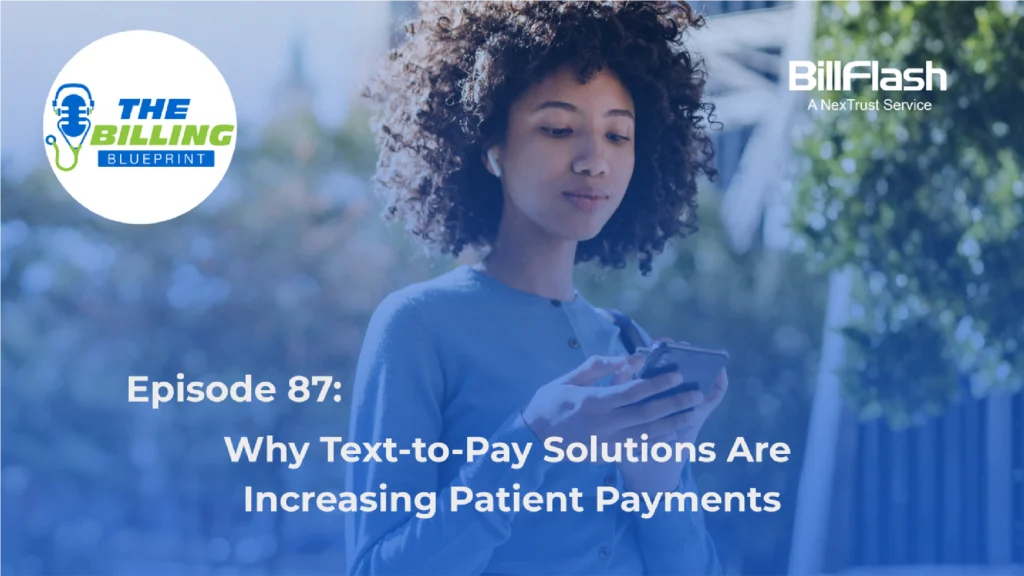
Healthcare practices are embracing text-to-pay solutions to simplify patient billing, reduce administrative burden, and accelerate payments. In this episode, we explore how automated patient billing, text-to-pay solutions, and digital payment reminders are transforming the patient financial experience while helping practices improve cash flow.
Discover why patients are far more likely to engage with text messages than traditional billing methods, how automation eliminates time-consuming manual follow-up, and why frictionless mobile payment options are helping practices collect payments faster. Whether you're looking to modernize your billing process or optimize your revenue cycle, this episode explains why text-to-pay solutions have become an essential part of today's healthcare payment strategy.
Transcript
Narrator: 00:00
Welcome to the Billing Blueprint Podcast, your go to resource for innovative medical billing solutions. Each episode we explore the latest industry trends and share proven strategies to help your practice streamline operations and get paid faster. Now here are your hosts, Brad and Sarah.
Sarah: 00:23
I want you to take a second and just, you know, picture your phone screen right now to see it in your mind's eye.
Brad: 00:28
Oh, yeah, think about all those little red notification badges sitting on the corners of your apps.
Sarah: 00:32
Exactly. Like if you look at your email app, what is that number? Is it in the dozens, the hundreds?
Brad: 00:37
Or maybe you're one of those people where it's climbed into the tens of thousands and you've just, I don't know, accepted that as your reality.
Sarah: 00:44
Right now, shift your focus to your text message app. How many unread texts do you have?
Brad: 00:50
I mean, for the vast majority of you listening, that number is probably zero.
Sarah: 00:55
Or maybe it's one and it is actively bothering you that you haven't opened it yet. So why is it that you will happily ignore a $500 medical bill sitting in your email for six months, but you will instinctively reply to a text message in like, three seconds?
Brad: 01:11
It fundamentally comes down to how our brains categorize digital spaces. The email inbox has morphed into this sort of digital storage unit, but the text message inbox remains highly intimate.
Sarah: 01:22
Yeah, it's an environment that practically demands immediate attention. That visceral difference, the completely different psychological reaction you have to an email versus a text is what we are exploring today. Welcome to the Deep Dive.
Brad: 01:36
We are looking at a really fascinating shift in the healthcare space today based on an incredibly insightful article from BillFlash.
Sarah: 01:44
Yeah, they've been tracking the explosion of this text to pay movement in healthcare billing.
Brad: 01:48
Right. And on the surface, switching from sending an email to sending a text sounds like a minor administrative software update.
Sarah: 01:54
Just a little tweak.
Brad: 01:55
Yeah. But when you look at the underlying behavioral economics of how patients actually respond, the ripple effects are entirely restructuring how medical clinics survive financially, which is wild.
Sarah: 02:07
And that is the core mission for us today. We're going to explore exactly how automating billing workflows through text messaging creates this massive win situation.
Brad: 02:17
It really is a win.
Sarah: 02:18
We're talking about drama. Drastically reducing those soul crushing administrative tasks for medical staff while simultaneously driving much higher response and payment rates from patients like you.
Brad: 02:29
Because understanding this shift reveals a lot about our own psychology.
Sarah: 02:34
Totally. Okay, let's unpack this. Because I promise you, understanding this shift will completely change how you view the notoriously clunky healthcare billing system.
Brad: 02:43
Well, to appreciate the scale of this solution, you really have to look at the wreckage of the old system first.
Sarah: 02:49
Oh, it's a mess.
Brad: 02:50
It is. To understand why automated text workflows are a game changer, we first have to establish just how broken the old systems are when it comes to getting a patient's attention.
Sarah: 03:01
Right. And the data in the BillFlash report paints a pretty grim picture for those older methods.
Brad: 03:08
Text messages boast a 98% open rate.
Sarah: 03:10
Wait, 98%? That isn't just an improvement. That is practically a mathematical guarantee of visibility.
Brad: 03:17
It really is. And furthermore, 90% of texts are read within three minutes.
Sarah: 03:22
Three minutes.
Brad: 03:23
Yeah. And if you expand that window just a bit, 87% of consumers check their texts within 15 minutes.
Sarah: 03:30
So, the communication isn't just arriving in a digital mailbox waiting to be checked. It's practically tapping the patient on the shoulder in real time.
Brad: 03:40
That immediacy is everything. Just look at your own mobile first behavior. With 92% of adults owning a smartphone and 50 billion SMS sent globally every single day, healthcare is finally meeting you where you already live.
Sarah: 03:53
Right on your phone.
Brad: 03:54
Exactly.
Sarah: 03:54
Which makes total sense from a consumer perspective.
Brad: 03:58
But wait, doesn't texting patients individually just trade one manual task for another?
Sarah: 04:02
I see where you're going with this.
Brad: 04:04
Like how does typing out texts save a medical receptionist any actual time? If I have a thousand patients typing a thousand texts sounds like a nightmare.
Sarah: 04:12
Yeah. That is a highly common but crucial misconception. We are not talking about manual texting here.
Brad: 04:18
It's not about a human being sitting at a desk typing out messages. It's about automated workflows.
Sarah: 04:24
Right. The software does the heavy lifting.
Brad: 04:26
Exactly. To understand why this rescues the staff, you have to picture the immense administrative burden of the old way.
Sarah: 04:35
Let's walk through that. What does a typical Tuesday look like for a billing specialist doing it the old way?
Brad: 04:40
It is an agonizing, endless cycle of phone tag staff spending hours every single day pulling lists of unpaid accounts, making follow up calls and dealing with voicemail delays.
Sarah: 04:51
Oh, the voicemail.
Speaker 1: 04:52
Right.
Brad: 04:53
They call a patient at 10am but the patient is at work, so it goes to voicemail. The patient listens on their lunch break, calls back at 12:30, but now the receptionist is at lunch.
Sarah: 05:02
It's just a nightmare.
Brad: 05:03
It leads to so much mutual frustration.
Sarah: 05:05
So, the automated solution steps in and entirely bypasses human involvement in that initial contact phase.
Brad: 05:11
Precisely.
Sarah: 05:11
The report highlights some specific BillFlash automated features that show how these function in practice. Like this PreBill feature.
Brad: 05:18
Yeah. PreBill is fascinating because it allows practices to send a request for payment before the appointment even takes place.
Sarah: 05:25
Right. Which totally improves upfront collections. Instead of chasing you down three weeks after your procedure, they establish that financial transparency before you even walk in the door.
Brad: 05:35
And the staff didn't have to dial a single number. The automation just triggers it based on the schedule.
Sarah: 05:39
Exactly. And then you have the follow ups. I like to think of this feature, they call it pay reminders as a polite but incredibly persistent robot butler.
Brad: 05:48
Or robot butler. I like that.
Sarah: 05:50
It's true. These automated text and email reminders are sent on a schedule, say up to three times a month to keep the balance top of mind.
Brad: 05:57
Right. But the most important part of that robot butler is that it actually pays attention.
Sarah: 06:02
Yes. The automation automatically stops the second the payment is received.
Brad: 06:06
Exactly.
Sarah: 06:07
It requires zero manual effort from the billing staff to cross reference who is paid today and who still needs a reminder. The workflow actively manages itself.
Brad: 06:17
The downstream effect of that is massive. The staff gets their hours back. They can actually dedicate their time to the patients physically standing in front of them in the waiting room.
Sarah: 06:27
So, we've established that automation frees up the staff. Here's where it gets really interesting, though.
Brad: 06:32
Okay. Lay it on me.
Sarah: 06:33
Why does receiving a text actually make you, the patient, more likely to open your wallet and pay faster?
Brad: 06:39
Oh, this is the best part. It comes down to one thing. Eliminating friction.
Sarah: 06:44
Right. Because delays often happen simply because patients leave paper bills unopened or just forget them on the counter.
Brad: 06:50
Exactly.
Sarah: 06:51
Like the gap between seeing the bill and paying the bill is where the entire process breaks down.
Brad: 06:56
It really is. Every extra step is a hurdle. But the data shows that 51% of patients explicitly claim that text notifications prompt them to pay outstanding bills more quickly.
Sarah: 07:08
Over half. That is a huge behavioral shift. Why does that happen?
Brad: 07:12
Because the text-to-pay solution provides a secure clickable link directly to mobile friendly payment portals. The source mentions portals like PayWoot.com for example.
Sarah: 07:22
Right. So, you aren't typing a huge URL into a browser.
Brad: 07:26
No, you just tap your screen.
Sarah: 07:27
And the experience after you tap that link is critical because it utilizes this specific payment option that is basically guest checkout magic.
Brad: 07:36
Yes. Removing the login hurdle is huge. Yeah, patients don't even need to remember a password. They can just use guest pay for guest checkout.
Sarah: 07:45
Nobody wants to reset a password just to pay a $40 copay.
Brad: 07:48
Nobody. And once you're in, you're given highly flexible modern payment options.
Sarah: 07:54
Right. Tools you already use like ach, Apple Pay, Google Pay, regular credit cards.
Brad: 07:59
They even offer self-serve payment plans like PlanPay and patient financing options like FlexPay.
Sarah: 08:05
So, if the bill is too high, you can just tap a button and split it into monthly payments right there on your phone.
Brad: 08:10
Exactly. You have to remember that this is all about immediacy. By mirroring the frictionless checkout experiences, you expect in retail and banking, healthcare billing is finally catching up, removing all those.
Sarah: 08:21
Removing all those annoying barriers that make you procrastinate on your medical bills.
Brad: 08:25
Because human behavior is dictated by the perceived effort of the action, less effort means faster payments.
Sarah: 08:32
So, when you combine a massive reduction in staff admin work with a frictionless, highly open payment method for patients, what is the macro level result for the healthcare industry?
Brad: 08:44
Well, the 2026 data really tells the story here. Right now, 93% of patients actually opt in to receive text from their providers.
Sarah: 08:52
93. That's almost universal.
Brad: 08:54
It is. And 59% explicitly prefer text notifications for.
Sarah: 08:59
Bills over paper or email.
Brad: 09:00
Right. In fact, 62% of patients prefer digital notifications over traditional ones across the board.
Sarah: 09:06
Wow.
Brad: 09:07
Yeah. If we connect this to the bigger picture, it reveals the ultimate financial impact for these clinics. Text-to-pay technology and instant mobile first transactions can reduce a healthcare organization's accounts receivable by up to 65%.
Sarah: 09:21
Up to 65%. Just to clarify, for anyone listening, accounts receivable is basically the money patients owe that hasn't been paid yet. It is revenue trapped in limbo.
Brad: 09:28
Exactly. It's trapped capital.
Sarah: 09:30
So, freeing up 65% of that trapped money is massive. It shows that faster communication is no longer just a neat feature.
Brad: 09:37
Not at all.
Sarah: 09:38
It's a competitive advantage that's literally required to maintain a connected patient financial experience and optimize cash flow.
Brad: 09:47
Absolutely. It's the difference between a clinic merely surviving and a clinic actually thriving.
Sarah: 09:52
So, what does this all mean? Let's recap the core journey of our deep dive today.
Brad: 09:57
It's been quite a shift to look at.
Sarah: 09:58
By swapping phone tag and lost mail for automated SMS workflows, medical staff get their time back.
Brad: 10:05
The robot butler handles the ledgers.
Sarah: 10:07
Exactly. And patients get a simple, frictionless way to pay that fits right into their daily digital habits.
Brad: 10:14
It completely rewires the operational efficiency of the practice.
Sarah: 10:17
It really does.
Brad: 10:18
You know, it leaves me with a final thought for everyone listening to mull over. The healthcare industry is notoriously one of the slowest sectors to adopt new technology, right?
Sarah: 10:25
Oh, notoriously slow. Bureaucratic nightmares.
Brad: 10:29
Exactly. So, if health care is now successfully utilizing mobile first one-click text payments to dramatically change human behavior and settle debts. Yeah, what other highly traditional bureaucratic areas of your life, like government property taxes or legal fees, are about to be completely rewired by the simple power of a text message?
Sarah: 10:52
Oh wow. The idea of the DMV sending me a text instead of making me wait in line for three hours.
Brad: 10:57
It might be closer than you think.
Sarah: 10:59
I would welcome that with open arms. Definitely something to think about. Thanks for joining us on this deep dive into the changing landscape of healthcare billing. We'll catch you all next time.
Narrator: 11:09
Thanks for tuning into the Billing Blueprint podcast. For more insights or to dive deeper dive deeper into today's topics. Head over to billflash.com. Don't forget to subscribe and we'll catch you next week with more strategies to keep your practice running smoothly and getting paid faster.
Sources:
Text Messages Have a 98% Open Rate – The Power of Text to Pay in Healthcare Billing