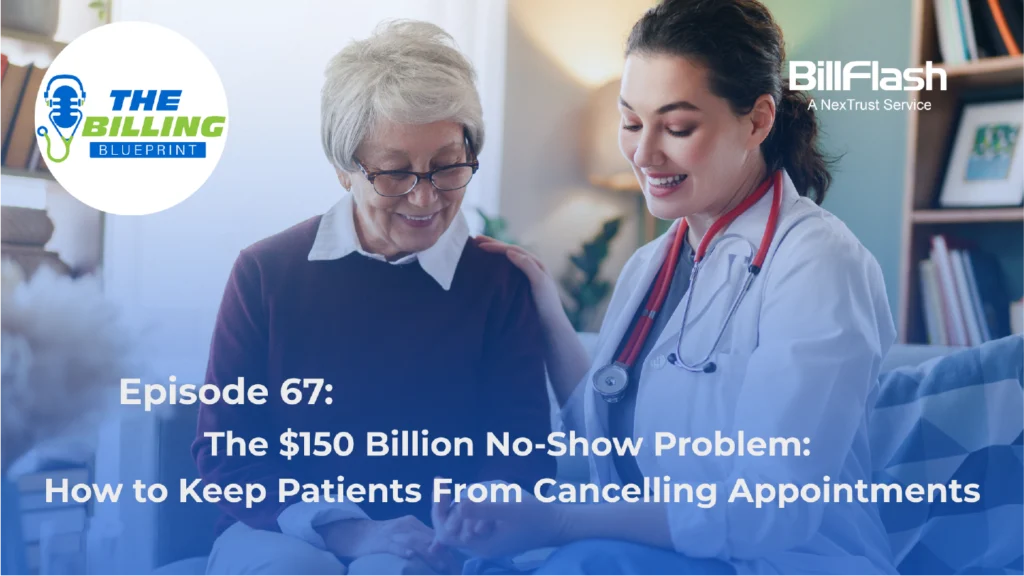
Patient no-shows cost the U.S. healthcare system an estimated $150 billion every year—roughly $200 per missed appointment and more than $50,000 per provider annually.
But cancellations in 2026 aren’t about forgetfulness.
They’re about financial fear.
In this episode, How to Keep Patients From Cancelling Appointments, we unpack the real drivers behind rising no-shows—from deductible resets and economic stress to staffing shortages and long booking gaps. We explore how “financial ambiguity” quietly erodes trust, disrupts schedules, and drains revenue.
More importantly, we break down five practical strategies practices can implement right now, including:
- Pre-visit cost transparency
- Flexible payment plans and patient financing
- Hybrid mail + digital billing experiences
- Automated payment reminders
- Creating a truly patient-centered financial experience
Because when patients cancel, they’re often not rejecting care — they’re rejecting uncertainty.
If you want to reduce cancellations, protect cash flow, and ease staff burnout, this deep dive is for you.
Transcript
Narrator: 00:00
Welcome to the Billing Blueprint Podcast, your go to resource for innovative medical billing solutions. Each episode we explore the latest industry trends and share proven strategies to help your practice streamline operations and get paid faster. Now here are your hosts, Brad and Sarah.
Sarah: 00:20
I mean, $150 billion, that’s
Brad: 00:22
the GDP of a small country.
Sarah: 00:25
Exactly. But we aren't talking about national debt here or infrastructure spending or anything like that. That 150 billion is literally the estimated annual cost of patients simply just not showing up.
Brad: 00:37
Right. No shows and late cancellations. It is essentially the ghost revenue of the entire US healthcare system.
Sarah: 00:44
It's completely staggering. And that's what we're really digging into today. For those of you listening, we are doing a deep dive into the state of patient cancellations.
Brad: 00:52
Yeah. And it's a critical time to be looking at this.
Sarah: 00:54
It really is. We've got this great stack of data specifically looking at strategies from BillFlash on why this is happening. And honestly, the why is a lot more complex than I expected. I think, I think most of us just assume it's people forgetting to check their calendars.
Brad: 01:10
Oh, absolutely not. No. If you look at the specific trends for 2026, forgetfulness is actually a really shrinking piece of the piece of the drivers now are much more economic and psychological.
Sarah: 01:23
Right.
Brad: 01:23
But before we get to the psychology, I think we really need to ground this in the reality of the people listening to this. You know, the practice managers, the providers. Because $150 billion is this abstract headline number. It's really hard to feel that, yeah,
Sarah: 01:37
it's way too big to wrap your head around, but the research actually breaks this down to the practice level and that is where it really starts to hurt.
Brad: 01:44
That's where it becomes rent and payroll and new equipment. The data actually suggests that a single missed appointment averages out to about $200 in lost revenue.
Sarah: 01:53
Which, playing devil's advocate here, doesn't sound like a total catastrophe if it happens just once. You know, you take a breath, you catch up on charts, maybe grab a quick coffee.
Brad: 02:00
Exactly. One patient misses a checkup, fine. You catch up on your emails. But that is not the reality for most clinics. The conservative estimate for a busy practice is five no shows a week.
Sarah: 02:11
Wow.
Brad: 02:12
To do the math that, that's $1,000 a week. That is over $50,000 a year.
Sarah: 02:17
Per provider.
Brad: 02:18
Per provider. Right. So if you're running a multi physician practice with say four or five doctors, you are looking at a quarter of a million dollars just evaporating every single year.
Sarah: 02:29
That's insane.
Brad: 02:30
It's not just lost profit either. That's a nurse you can't hire. That's a new ultrasound machine you can't upgrade.
Sarah: 02:35
And that's really just the direct cash. Right. We haven't even touched on the operational mess it creates. I imagine it just throws the whole day off.
Brad: 02:42
Well, the ripple effect worse. Because a no show isn't just an empty room, it's a gap in the schedule that you just can't resell. It's what we call perishable inventory.
Sarah: 02:52
Like an airline seat.
Brad: 02:53
Exactly. Like an airline seat. Once that plane takes off, you can't sell that seat. Once the 2 o' clock slot passes with an empty room, that revenue is gone forever. But meanwhile, you have this huge wait list of patients who are just desperate to be seen.
Sarah: 03:07
That's the bitter irony here, isn't it? You have an access to care crisis going on simultaneously with a utilization crisis. People want appointments and yet appointments are just going unused.
Brad: 03:19
Precisely. And this actually leads us directly into the staffing loop, which is a huge factor right now in 2026. The sources draw a really interesting line here. We know there's a staffing shortage across all of healthcare, right?
Sarah: 03:33
Everybody feels that.
Brad: 03:33
And that naturally leads to longer booking times. So maybe you're booking three or four weeks out for just a routine visit.
Sarah: 03:40
which feels like a lifetime when you're sitting there worried about a symptom.
Brad: 03:43
It really does. And the data shows a direct correlation here. The longer the gap between the booking and the actual appointment, the higher the disengagement rate.
Sarah: 03:52
Disengagement, that's a very clinical term. What does that actually look like for the patient on the ground?
Brad: 03:57
It basically means they drift away. Maybe they fix the problem themselves with some over the counter meds. Maybe they find an urgent care down the street that can see them today. Or unfortunately, maybe they just decide the hassle isn't working worth it and they stop seeking care altogether, just give up on it. Yeah, but the result is exactly the same for the clinic. When the appointment date finally arrives, they just don't show up.
Sarah: 04:19
So we've got the system that is bleeding money and wasting time. The big question and really the mission for this deep dive is why is it getting worse right now? The notes mention something called financial fear. Is this just about inflation?
Brad: 04:34
It's related to inflation, sure, but it's much more specific. This is the heavy hitter for 2026. Yeah, we used to always cancellations to flakiness like, oh, patients just don't respect the doctor's time.
Sarah: 04:46
Right.
Brad: 04:46
But the Research from BillFlash points to something much more sympathetic. Actually, they are just terrified of the bill.
Sarah: 04:52
Which makes total sense. I mean, we've all been there, right? You walk into a mechanic or a doctor's office, and you have absolutely no idea if the bill is going to be 50 bucks or 500 bucks.
Brad: 05:00
And for a lot of Americans, that difference is totally catastrophic. The stats here paint a pretty grim picture. Honestly, 2 in 5Americans cannot cover an unexpected $400 expense.
Sarah: 05:11
2 and 5. That is nearly half the people sitting in your waiting room right now. If you're a provider listening to this.
Brad: 05:16
Exactly. So put yourself in their shoes for a second. You have an appointment next Tuesday. You know, your deductible might have reset or maybe your insurance changed at the start of the year. So you call the front desk and you ask, hey, what's this going to cost me?
Sarah: 05:29
And you get the classic answer, it depends, right?
Brad: 05:32
It depends on the coding. It depends on your coverage. That ambiguity is toxic. If I'm that patient and I'm looking at my bank account, I'm not going to risk walking into a surprise bill. So I just cancel. I don't cancel because I don't want to be healthy. I cancel because I literally can't afford
Sarah: 05:48
the risk that completely reframes the whole problem. It's not a compliance issue at all. It's an economic survival issue.
Brad: 05:54
Exactly. And that is why the solutions we're looking at today, these five specific strategies, they aren't about sending more calendar reminders or nagging people. They're about removing that financial friction.
Sarah: 06:06
Let's get right into those solutions then. The first one is labeled radical transparency, but the technical term the source uses is Pre-Visit Billing. Now, traditionally, billing is always the last thing that happens, right?
Brad: 06:17
Care first, bill later, or, you know, bill months later, which is even worse.
Sarah: 06:22
It's a terrible user experience. Could you imagine buying groceries, eating them, and then getting a bill three weeks later that just says market price?
Brad: 06:30
It wouldn't work in literally any other industry. So strategy one flips the script entirely. It moves the financial conversation to before the patient even walks in the door. The specific tool highlighted here is bill flash, PreBill.
Sarah: 06:42
Okay?
Brad: 06:43
And the concept is that you send the estimated charge, you know, the copay or the coinsurance via text or email a few days before the visit.
Sarah: 06:51
Okay, but hold on. Practically speaking, for the practice manager listening to this right now, does this create a massive workflow bottleneck? Like, do the staff have to generate a full formal invoice for every single patient three days in advance, because that sounds like a total nightmare.
Brad: 07:05
No, and that's the really clever part. The sources are very clear on this. It doesn't require a formal statement generation at all. It's just an estimate or a charge. The patient gets a text with a link to paywoot.com they see the amount, say $40, and they pay it right on their phone while they're sitting on their couch.
Sarah: 07:24
Okay, so I can definitely see the efficiency gain there. Obviously no awkward credit card fumbling at the front desk while the phone is ringing off the hook. But what does that actually do to the psychology of the patient we just talked about? The one who's scared of the cost?
Brad: 07:39
It eliminates the surprise bill anxiety completely. The moment I pay that $40 on Tuesday for my appointment on Thursday, the transaction is closed. In my mind. I know exactly what it costs. I'm not sitting there worrying about it anymore.
Sarah: 07:52
It essentially turns a medical visit into something. Something more like buying a movie ticket. You pay, you show up, you experience the service without the hanging sword of the bill over your head.
Brad: 08:01
It completely clears the mental deck. And for the staff, it transforms the whole check in process. Instead of acting as debt collectors asking for cards and signatures, they are just welcomers. Hi, good to see you. Head on back. It changes the entire temperature of the waiting room.
Sarah: 08:17
That's a great point. And that actually leads us right into the second strategy, which feels really specific to a certain time of year, but I guess applies anytime, really. The source calls it the January hangover.
Brad: 08:28
Ah, yes, the dreaded deductible reset.
Sarah: 08:31
I feel like this just gets worse every single year.
Brad: 08:33
It really does, because deductibles keep getting higher and higher. You have patients who've been cruising along paying $20 co pays all autumn because they met their deductible way back in May. Right then January 1st hits the clock, resets, and suddenly that exact same routine visit costs $250.
Sarah: 08:51
And the source argues this is a prime danger zone for cancellations.
Brad: 08:54
It is the absolute highest risk, period. Patients see that huge price hike and they panic. They literally just don't have the cash flow to handle a 1000% increase in cost overnight. So strategy two is all about payment flexibility. You have to break the big numbers into small numbers.
Sarah: 09:12
The source breaks this down into two flavors. Basically, installments and financing. I think most people know what installments are. PlanPay is the tool mentioned here.
Brad: 09:21
Right, right. BillFlash PlanPay. That's your standard payment plan. You owe $300, pay us $75 a month. For four months. The practice is effectively acting as the bank there. Okay, it works and it helps the patient. But the practice still takes the risk of non-payment. If the patient just stops paying after month two from, you're stuck chasing them right now.
Sarah: 09:42
The second option, BillFlash Flex pay, seems significantly different. It's financing. Now, I have to be honest. Usually when I hear medical financing, I immediately think of elective surgeries, I plastic surgery or Lasik, things that cost thousands. And I think of predatory interest rates.
Brad: 09:55
Yeah, yeah, that's the traditional model for sure. And usually that requires a stellar credit score too. But FlexPay is aiming at a totally different demographic. It's designed for the day to day medical bills that catch regular people off guard.
Sarah: 10:08
The approval rate statistic in the notes really jumped out at me.
Brad: 10:11
90% approval and no hard credit check.
Sarah: 10:15
That is the key right there. Because if you have a patient struggling to pay a $400 bill, they probably do not have an 800 credit score. If you run a hard check, you ding their score and reject them, which helps literally nobody.
Brad: 10:28
Exactly. They are accepting scores as low as 500. This is really an inclusivity play. It effectively removes the affordability barrier for almost the entire patient base. But for the doctor, here is the real wow factor. The financing company pays the doctor in full immediately.
Sarah: 10:45
So the risk is transferred entirely off the practice's books.
Brad: 10:48
Completely. The patient owes the financing company, not the doctor. The doctor gets their revenue, the patient gets a manageable monthly payment, and crucially, the appointment stays on the calendar.
Sarah: 10:59
It seems like such a no brainer, but I imagine a lot of practices are still stuck in the old way of just mailing a bill and hoping for a check.
Brad: 11:06
Which brings us perfectly to the communication paradox. This covers strategies three and four combined. We have this assumption now in 2026 that everything must be digital. We assume paper is just dead.
Sarah: 11:18
Yeah, I haven't bought stamps in three years. I don't even know where my checkbook is, to be honest.
Brad: 11:23
You might not have, but the research shows that 74% of patients still prefer to receive medical bills by mail.
Sarah: 11:30
Wait, really? 74%? That seems incredibly high for 2026. Is that just an older demographic holding on to the past?
Brad: 11:37
It definitely skews older, sure, but it's surprisingly robust across all age groups. There is something about a medical bill that just feels serious. It's an official record. People want to hold it, file it, check it against their explanation benefits. And email just feels ephemeral, right? It feels like something you can accidentally delete or that just goes straight to spam.
Sarah: 11:57
Okay, I can see that. It's the officialness of it. But here's the paradox, right? If they want the bill by mail, do they actually want to write a physical check? Because that is definitely where I draw the line.
Brad: 12:09
No, that's the conflict. Over half of those exact same people want to pay online. They want the trigger to be analog, the actual piece of paper, but they want the action to be digital.
Sarah: 12:21
So how do you even bridge that? You can't click a piece of paper.
Brad: 12:24
You use the bridge that everyone finally learned how to use during the pandemic. The QR code.
Sarah: 12:29
Ah, the comeback kid of technology.
Brad: 12:31
It really is. The strategy here is bill flash mailed bills, but specifically utilizing that QR code feature. So the patient opens the envelope, gets that tactile satisfaction of, okay, I have the official bill. They scan the code with their camera and it lands them directly on paywoo.com
Sarah: 12:46
so they don't have to type in a 16 digit account number or remember some password they set up three years ago.
Brad: 12:52
No login friction at all. Scan, verify, pay. It takes maybe 10 seconds. You aren't forcing grandma to navigate a complex portal she doesn't understand. But you also aren't forcing the millennial to go find a mailbox. It completely satisfies both psychological needs.
Sarah: 13:09
That is really smart. It acknowledges that we are still in this weird transition period between paper and digital. But on the flip side, for the people who do want digital first, you have the automation side, right?
Brad: 13:20
Strategy four is bill flash pay reminders. And this really addresses the chase. Think about how much time a practice manager spends printing out lists of overdue accounts and asking their staff to go call them.
Sarah: 13:31
That's the worst part of the job. Nobody wants to make that call and nobody wants to receive it. It's just super awkward.
Brad: 13:37
It's a massive morale killer. Automation solves this with a set it and forget it cadence. The system sends texts and emails on a schedule. Maybe day seven, day 14 and day 21.
Sarah: 13:47
Is there a risk of nagging, though? Like, if I get six messages in a single month, I'm just going to block the number?
Brad: 13:51
There is a fine line, yes, but the system has smart logic built in. It stops the second the balance is paid. So if you pay on the very first text, you get silence after that. And frankly, most people actually want the reminder that they aren't dodging the bill on purpose. They're just busy.
Sarah: 14:08
Right?
Brad: 14:08
A text on a Tuesday afternoon that says, click here to pay $50 is actually helpful, not intrusive.
Sarah: 14:15
It's about reducing the cognitive load. I don't have to remember to pay because my phone just tells me to.
Brad: 14:20
Exactly. And all of this billing, the financing, the hybrid mail digital approach, it all culminates in strategy 5, the patient centered experience.
Sarah: 14:29
The source compares it to the Amazon experience, which is a pretty high bar to set.
Brad: 14:33
It is high, but think about your life outside of healthcare for a second. You can track a package from a warehouse in China to your front doorstep. You can pay your electric bill at 3am on a Sunday on your phone. You have total visibility and control. Then you enter the healthcare system
Sarah: 14:49
And you enter a time machine. Right back to 1995.
Brad: 14:52
Right? Opaque pricing, paper clipboards, bills that arrive three months late. The source makes a really critical point here. When billing is archaic, patients actually lose trust in the practice itself.
Sarah: 15:05
That's a harsh judgment, but I think it's totally valid. If you can't get the simple invoice right, can I really trust you to get my diagnosis right?
Brad: 15:12
We judge the whole by the parts we interact with. If the administrative experience is just full of friction, we naturally assume the clinical experience will be too. And when trust drops, engagement drops. And when engagement drops, they cancel. They cancel. So this entire ecosystem, PreBill, flex, pay, pay, reminders, it's not just about accounting. It's about showing the patient, hey, we value your time, we value your sanity, and we're going to make this easy for you.
Sarah: 15:37
It transforms the practice from just being a service provider into an actual partner.
Brad: 15:41
Exactly.
Sarah: 15:42
So let's wrap this up. We started with $150 billion problem. We found out that patients aren't just being lazy. They are financially stressed at navigating a really confusing system.
Brad: 15:52
And the fix is meeting them exactly where they are. Transparency before the visit, flexibility during the payment, and automation to keep them on track.
Sarah: 16:03
For you, the listener. Whether you're running a small clinic or a massive hospital system, why does this really matter today?
Brad: 16:10
Because the cost of doing nothing is rising. Cancellations are going up. If you can save even five appointments a week by offering financing or PreBilling, that is $50,000 a year back in your pocket. But much more importantly, it's five patients who actually got the care they needed.
Sarah: 16:28
and five staff members who didn't have to spend their lunch break calling no shows.
Brad: 16:32
The burnout reduction is very real. When you automate the busy work, your staff can get back to actual patient care. That's the real win-win here.
Sarah: 16:39
I want to leave everyone with a final thought to chew on. We often take cancellations personally, like they didn't want to see me.
Brad: 16:45
It's really hard not to take it personally.
Sarah: 16:47
But based on everything we've looked at today, I have to ask When a patient cancels an appointment, are they actually rejecting your medical care, or are they just rejecting the financial ambiguity surrounding it?
Brad: 16:57
That's the real question. If we fix the transparency, do we fix the health outcome?
Sarah: 17:03
I think the evidence strongly suggests we do. Thanks for going on this deep dive with us.
Narrator: 17:08
Thanks for tuning into the Billing Blueprint podcast. For more insights or to dive deeper dive deeper into today's topics. Head over to billflash.com. Don't forget to subscribe and we'll catch you next week with more strategies to keep your practice running smoothly and getting paid faster
Sources:
How to Reduce Patient Cancellations in 2026: Proven Strategies for Busy Healthcare Practices