Transcript
Narrator: 00:01 Welcome to the Billing Blueprint Podcast, your go to resource for innovative medical billing solutions. Each episode we explore the latest industry trends and share proven strategies to help your practice, streamline operations and get paid faster. Now here are your hosts, Brad and Sarah.
Brad: 00:23 Imagine having, like, the best doctor in the world, someone who actually listens, someone who finally figured out that obscure pain you’ve been having. Or maybe someone who literally saved your life.
Sarah: 00:35 Right, the ideal healthcare experience.
Brad: 00:38 Exactly. But now imagine never going back to them again simply because paying their front desk was just an absolute nightmare.
Sarah: 00:45 Oh, yeah, it happens way more than you’d think.
Brad: 00:48 It sounds crazy, but today we’re looking at a staggering statistic that shows nearly everyone listening to this has reconsidered returning to a healthcare provider because of, well, a broken billing experience.
Sarah: 01:00 It is a massive blind spot in the industry, honestly. We always evaluate healthcare based on clinical outcomes, but the patient evaluates the entire journey, which begins and ends with that financial transaction.
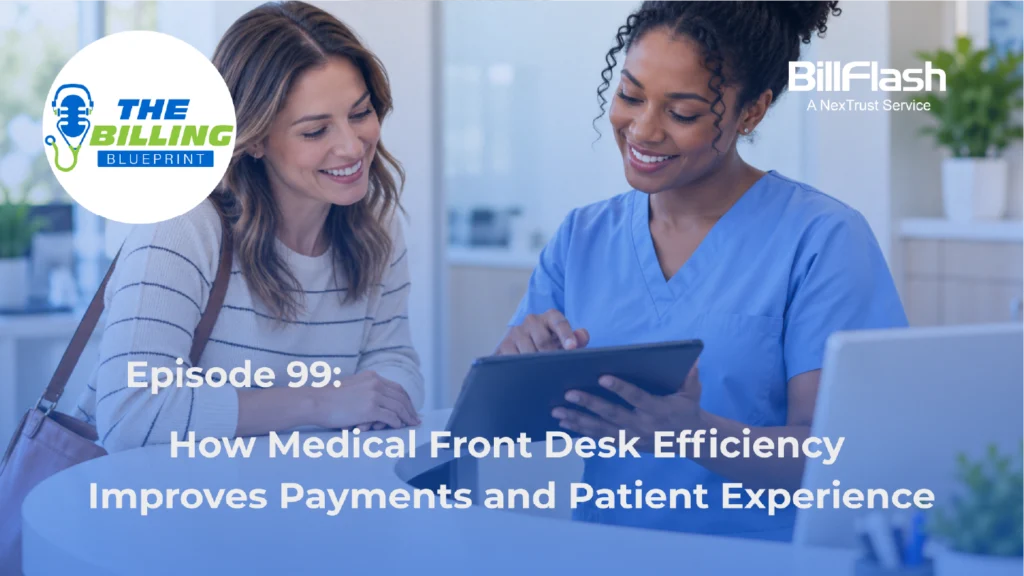
Brad: 01:13 Totally. And before we get into the mechanics of why that journey is so broken, I have to take a quick second to announce that this is officially our 99th deep dive.
Sarah: 01:22 I can’t even believe it.
Brad: 01:23 I know, right? We are brewing up something special for our massive 100th milestone next time, so you’ll definitely want to stick around for that. But today our mission is unpacking the hidden chaos of the medical front desk.
Sarah: 01:37 Yes, the dreaded front desk.
Brad: 01:39 Right. We are looking at insights from BillFlash, which was created by NexTrust, to understand how untangling the whole medical billing process fundamentally reduces staff burnout and, frankly, saves the patient experience.
Sarah: 01:52 Which is vital context for you listening to this, because whether you’ve been that frustrated patient sitting in a waiting room wondering why the line just isn’t moving.
Brad: 02:01 Oh, I’ve been there.
Sarah: 02:02 Right. Or whether you manage a team and need to understand how operational friction destroys morale, the medical front desk is basically the ultimate case study in system failure.
Brad: 02:11 It really is.
Sarah: 02:12 It’s a critical choke point. It sets the tone for the entire care experience.
Brad: 02:17 Okay, so let’s unpack this setup. If you actually stand back and watch what a medical front desk worker is doing on, like, a Tuesday morning, it is an impossible juggling act.
Sarah: 02:29 Oh, absolutely.
Brad: 02:30 I mean, they are answering ringing phones, processing check-ins, verifying insurance limits on some glitchy portal, scheduling follow-ups for patients, checking out and fielding highly complex payment questions all simultaneously.
Sarah: 02:44 And they are doing it while the people standing right in front of them are often sick, anxious, or just in physical pain.
Brad: 02:51 Yeah, that’s a great point.
Sarah: 02:52 That environment alone is stressful enough, but when you introduce the concept of billing into that specific space, you create this intense psychological conflict for the staff.
Brad: 03:02 Because they have to play, you know, two completely different roles at the exact same time.
Sarah: 03:07 Yes, exactly. I mean, the front desk worker is supposed to be the welcoming face of a healing environment. Their job is comfort.
Narrator: 03:15 Right.
Sarah: 03:15 And administration. But the moment an outstanding balance pops up on their screen, they suddenly have to pivot and act as a debt.
Brad: 03:21 Collector, which is so awkward.
Sarah: 03:23 It really is. They have to navigate these incredibly tense conversations about money, and they have to do it without derailing the patient’s actual medical care.
Brad: 03:30 It’s like air traffic control. But you’re also asking the controllers to pause what they’re doing, get on the radio and negotiate the runway fee with a pilot.
Sarah: 03:38 While the plane is landing?
Brad: 03:39 Yes. While the plane is actively trying to land, it completely disrupts the primary objective.
Sarah: 03:44 And that disruption shows up so clearly in the financial data. The Medical Group Management Association, or MGMA, found that 56% of medical practices recently saw their days in accounts receivable increase.
Brad: 03:56 Wow.
Sarah: 03:57 Yeah. Meaning it is taking longer and longer for clinics to actually get the money they are owed.
Brad: 04:02 See, I would normally assume that’s just, you know, macroeconomics, like inflation goes up, people have less disposable income, so they delay paying the bills.
Sarah: 04:10 You’d totally think so. But the primary driver wasn’t patient insolvency. The primary driver was staffing disruptions and turnover, specifically in billing and collection roles.
Brad: 04:21 Wait, so over half of these medical practices are waiting longer to get paid simply because they literally cannot keep the front desk fully staffed?
Sarah: 04:29 Yeah. That is the vicious cycle of manual processes. When staff are forced to use disconnected systems, like logging out of a scheduling software just to log into a different payment software.
Brad: 04:41 That sounds miserable.
Sarah: 04:42 Or relying on manual phone calls to remind people to pay. It creates a massive bottleneck. That operational friction leads directly to critical errors.
Brad: 04:51 And I’m guessing errors lead to rejected claims.
Sarah: 04:54 Exactly. Errors lead to insurance claim denials. Denials delay the clinic’s cash flow. And then the delayed cash flow forces the remaining staff to work twice as hard to chase down the money, which.
Brad: 05:05 Burns them out, causing them to quit.
Sarah: 05:07 You got it. And the cycle repeats.
Brad: 05:09 Man, the system’s just cannibalizing itself at the point of care. Which logically means if the physical desk is the bottleneck, the only way out is to move the financial transaction away from the waiting room entirely. You have to shift the timeline.
Sarah: 05:24 That brings us exactly to the concept of pre-visit billing, or PreBill solutions. If the chaos happens at the time of the appointment, you move the money before they ever step foot in the building.
Brad: 05:36 Meaning you, like, text or email the patient their expected balances, like their standard copay or their deductible contribution, days before the visit.
Sarah: 05:45 Exactly right.
Brad: 05:46 And this applies to both in-office visits and telehealth. You’re giving the patient time to look at the costs in the comfort of their own home, maybe check their bank account, rather than springing it on them while a line of coughing people is standing behind them.
Sarah: 06:00 It introduces much needed predictability into an unpredictable environment. But even for the payments that do have to happen in the office, the friction just has to be removed. I mean, 93% of patients state that their decision to return to a healthcare provider is directly impacted by the quality of their billing experience.
Brad: 06:20 That statistic is just wild to me. 93%.
Sarah: 06:24 It’s huge.
Brad: 06:25 You could have a world-class surgeon, but if paying that surgeon requires a confusing portal and, like, a 20 minute hold time on the phone, almost everyone is looking for a different doctor next time.
Sarah: 06:35 The mechanics of the payment matter just as much as the medicine when it comes to patient retention. In fact, 25% of people reported being unable to pay a medical bill on time simply because their preferred credit card option wasn’t readily available.
Narrator: 06:49 Really?
Brad: 06:50 Just because of the card option?
Sarah: 06:51 Yeah. We are operating in an era where people do not carry checkbooks. And honestly, many don’t even carry physical wallets anymore.
Brad: 06:59 Which makes modern payment options totally non-negotiable. The baseline now requires accepting ACH, which are just direct electronic bank-to-bank transfers, alongside your standard card chip swipe and mobile wallets, like Apple Pay or Google Pay.
Sarah: 07:16 Exactly. You have to have it all.
Brad: 07:18 But here’s where I actually want to push back a little bit. We’re assuming everyone just wants to tap their phone and walk away. Is it really that simple to get a patient to automate their medical bills?
Sarah: 07:30 What do you mean?
Brad: 07:31 Well, buying a coffee on an app is one thing, but giving a clinic my card on file for a medical procedure feels like, I don’t know, handing them a blank check.
Sarah: 07:40 Right, and that skepticism is exactly why medical billing has lagged so far behind retail. Patients are historically wary of medical costs because they are notoriously opaque.
Brad: 07:50 Yeah, you rarely know what a visit will actually cost until, like, three weeks later.
Sarah: 07:54 Exactly. But providing secure, automated online options, systems like StoredPay, AutoPay, and PlanPay, is how you actually change that psychology.
Brad: 08:04 How do those tools actually convince a skeptical patient to opt in, though? Like, what’s the hook?
Sarah: 08:09 By giving the control back to the patient. For returning patients, tools like AutoPay remove what we call the desk ambush.
Brad: 08:17 The desk ambush. I like that.
Sarah: 08:19 Right. Instead of walking in, holding your breath, and waiting for the receptionist to announce your total out loud to the whole room, you have an automated self-service agreement.
Brad: 08:28 Okay, so you authorize the clinic to charge your card on file for a capped amount, say, just a $50 standard copay.
Sarah: 08:35 Yes. Or you set up a monthly installment plan that runs automatically. It basically replaces the anxiety of the unknown with the comfort of parameters that you agree to in advance.
Brad: 08:45 You’re completely removing the cognitive load. I don’t have to think about the transaction, and the front desk worker doesn’t have to manually process my card for the 12th time this year. We both win.
Narrator: 08:55 Right?
Brad: 08:56 But that assumes I pay up front or have an ongoing arrangement. What happens after the visit, for a totally new bill? How do you actually get the statement to the patient without it getting lost in the noise?
Sarah: 09:07 Ah, this reveals one of the most fascinating contradictions in modern consumer behavior. It’s a delivery paradox.
Brad: 09:14 Okay, I am genuinely stuck on this part because the data completely surprised me.
Sarah: 09:19 Oh, it surprises everyone, right?
Brad: 09:21 On one hand, we have the ease of eBills. Clinics can send a text or an email on the exact same day a bill is approved. They use a simple digital template, click a few buttons, and send out a massive batch of bills instantly.
Sarah: 09:35 It’s cheap, it’s fast, it’s entirely digital.
Brad: 09:38 But then the data shows that 54% of patients report feeling more confident reviewing important billing information when it arrives by physical snail mail.
Sarah: 09:49 Yes, in a world where we manage our entire lives on glass screens, over half the population wants a piece of paper for their healthcare bills.
Brad: 09:59 Why, though? I get every other bill on my phone. Why is healthcare the exception?
Sarah: 10:04 Because of digital overload and the sheer stakes of the information. People want the efficiency of digital processing on the back end. They want the clinic to process their insurance instantly. They want a seamless payment gateway.
Brad: 10:15 Sure, that makes sense.
Sarah: 10:16 But they crave tangibility on the front end when the stakes are high. A medical bill is not a $10 streaming subscription. It carries significant financial and emotional weight.
Brad: 10:25 That’s true. An email can get swallowed by a spam folder, or, you know, you accidentally swipe it away on your lock screen while you’re holding groceries and it’s just gone forever.
Sarah: 10:34 Precisely why paper is so effective here. A piece of paper sits on your kitchen counter. It physically occupies space in your home.
Brad: 10:42 Yeah, it’s staring at you.
Sarah: 10:43 Exactly. It demands your attention, but it allows you to process that information on your own terms, at your own pace.
Brad: 10:49 It’s the physical weight of the debt. And BillFlash bridges this digital-physical divide so brilliantly with their mailed statements. They send physical statements that include a custom QR code on the paper, and the clinic can trigger this entire physical mailing process in just three clicks.
Sarah: 11:06 Yeah, the clinic gets the digital efficiency, meaning the staff doesn’t have to spend a Friday afternoon printing, folding, stuffing, stamping, and mailing envelopes, which sounds awful, but the digitally fatigued patient still gets their comforting piece of physical mail.
Brad: 11:19 And when they finally open it on a Sunday morning and decide to pay, they don’t have to, like, mail a check back. They just scan the QR code with their phone camera and pay instantly.
Sarah: 11:28 It’s blending the psychological comfort of the 1990s with the payment speed of the 2000s. I love that it is entirely about meeting the human where they are. And for those who do prefer purely digital communication, the system uses PayReminders. These are automated texts and emails that go out on a set schedule, usually.
Brad: 11:47 Up to three of them, which saves the staff from having to manually track who paid and who needs an annoying phone call.
Sarah: 11:53 Even better, the PayReminders sync directly with the payment gateway, so the automated messages stop the exact millisecond a payment is received.
Brad: 12:02 Oh, that’s so smart.
Sarah: 12:03 It completely eliminates the scenario where a staff member awkwardly calls a patient to collect a bill they literally already paid online 10 minutes ago, which is so.
Brad: 12:12 Frustrating as a patient, but okay, sending the bill perfectly, whether by QR code or text, only matters if the person opening it actually has the money in their bank account to pay it.
Sarah: 12:23 Right?
Brad: 12:24 What happens when the bills are simply too high for a normal family to absorb?
Sarah: 12:28 This is where the operational friction becomes a genuine crisis of care. The national survey data is pretty sobering. Nearly 7 in 10 U.S. adults received medical bills they could not afford to pay in full.
Brad: 12:42 7 in 10 U.S. adults. That is the vast majority of the population struggling with affordability.
Sarah: 12:47 It is. And of those carrying medical debt, 74% experienced negative impacts on their daily lives because of it.
Brad: 12:55 Man.
Sarah: 12:56 But for the clinics trying to keep their doors open and actually provide care, there is an even more alarming statistic. 20% of respondents changed their healthcare providers entirely out of fear.
Brad: 13:09 Fear of what? Like bad care?
Sarah: 13:11 Fear that they wouldn’t get quality medical treatment because of an unpaid bill.
Brad: 13:16 Wow, that is devastating. Like avoiding a doctor you trust, a doctor who has the entire history of you medically, simply because you owe them $500 and you are too ashamed to walk up to that front desk.
Sarah: 13:30 Exactly. And this brings us right back to the front desk worker. Of course, when patients are struggling with high deductibles and past due debt, the front desk is thrust into a role that they were never trained for. They become debt negotiators.
Brad: 13:44 Yeah.
Sarah: 13:44 And it forces a deeply uncomfortable dynamic that just poisons the patient provider relationship before the doctor even walks into the exam room.
Brad: 13:53 So how do you remove the front desk from that negotiation without the clinic just, well, going bankrupt?
Sarah: 13:59 By shifting to structured self-serve payment plans. The insights highlight two distinct tools: PlanPay and FlexPay.
Brad: 14:07 Okay, let’s look at PlanPay first.
Sarah: 14:09 Sure. So instead of a patient calling the front desk and haggling over how much they can afford this month, the clinic sets digital guardrails. The software might dictate a minimum monthly payment of $50 and a maximum duration of 12 months.
Brad: 14:23 And then the patient just logs online and builds their own installment plan within those parameters.
Sarah: 14:27 Yes. No phone calls, no negotiation, no shame. The patient manages their own debt privately. Then you have FlexPay, which is third-party patient financing.
Brad: 14:39 Wait, how does that work? How does the clinic not lose money if the patient stretches a payment out over, like, two years?
Sarah: 14:45 Because the clinic isn’t acting as the bank. In a FlexPay scenario, a financing partner pays the medical practice in full upfront.
Brad: 14:53 Oh, wow.
Sarah: 14:53 Yeah. The clinic gets their cash flow immediately, which keeps the lights on and pays the nurses. The patient then pays off the balance in monthly installments directly to the financing partner.
Brad: 15:04 That’s a massive win-win. The practice eliminates their accounts receivable risk entirely and the patient preserves their dignity.
Sarah: 15:10 Dignity is the operational word here. It preserves the dignity of the patient and the caretaking role of the staff. And when patients do have questions about these plans or their bills, the system supports that dignity through PayerMessages.
Brad: 15:21 PayerMessages?
Sarah: 15:22 Yeah, it’s a secure two-way messaging tool built directly into the PayWoot.com payment portal.
Brad: 15:28 I really love the mechanics of this because how often do you get a bill, see some weird charge, and think, did my insurance actually cover this?
Sarah: 15:35 All the time.
Brad: 15:35 Right. But you don’t want to call and wait on hold for 20 minutes just to ask a 10 second question.
Sarah: 15:40 Exactly. PayerMessages turns those disruptive real-time phone calls into asynchronous digital answers. A patient can send a message while reviewing their bill on the couch at 8:00pm.
Brad: 15:51 Nice.
Sarah: 15:51 And the front desk staff sees it in their queue the next morning and they answer it during a quiet moment between patient check-ins. It lowers the emotional temperature of the interaction and respects everyone’s time.
Brad: 16:00 Okay, but let’s look at the hardest cases. Even with self-serve payment plans, QR codes, and asynchronous messaging, some bills will just go unpaid.
Sarah: 16:09 Unfortunately, yes.
Brad: 16:10 And some insurance claims are going to be an absolute bureaucratic nightmare. So how does the back office handle the friction that can’t be automated away?
Sarah: 16:18 Well, providers often fail to collect 30 to 50% of outstanding patient balances. That is a massive volume of revenue just left on the table because it is too hard to chase.
Brad: 16:29 Down. Losing up to half of what patients owe would put most small businesses under instantly.
Sarah: 16:34 Which is why the solution cannot be forcing the front desk staff to make angry collection calls between scheduling appointments. The strategy utilizes integrated collections.
Brad: 16:44 So outsourcing it.
Sarah: 16:45 Yes, this brings in licensed recovery specialists to handle the severely overdue accounts. The clinic remains a place of healing. The collection agency handles the debt.
Brad: 16:55 Makes sense. But the patient collections are only half the battle, right? The other half is fighting the insurance companies to actually pay their portion.
Sarah: 17:02 Oh, definitely. That requires full Revenue Cycle Management, or RCM. And we need to look at how these RCM steps actually function to save staff time. It all begins with benefit verification before the patient even arrives.
Brad: 17:16 And this isn’t just checking if they have an insurance card. Right. It’s checking if their specific policy actually covers the specific procedure the doctor’s about to perform.
Sarah: 17:25 Exactly. It is checking the ID at the door, which prevents the dreaded denial three weeks later. Then you have claims submission and claims processing. Instead of just firing off a raw bill to an insurance company and crossing your fingers, professional coders act like a spell check for medical billing.
Brad: 17:42 Because a single transposed digit on a billing code means some algorithm at the insurance company will automatically reject a $5,000 claim.
Sarah: 17:50 Yes, it’s brutal. Professional coders ensure the exact diagnostic codes are mapped to the insurance company’s requirements. This pre-claim error reduction is followed by insurance follow-up and denial management, which is the rigorous appeals process for the claims that do get rejected.
Brad: 18:07 Doing all of this effectively requires a massive amount of software. And this brings us to a specific warning for clinics: the danger of the patchwork of vendors.
Sarah: 18:16 Oh, it’s a huge trap.
Brad: 18:18 Having one login for scheduling, a different website to run credit cards, a third vendor that mails the paper statements, and a completely separate, disconnected agency for collections.
Sarah: 18:27 It creates a labyrinth of data silos.
Brad: 18:30 Yeah, having a patchwork of vendors is like having one person take your restaurant order, a completely different company cook your food in a different building, and a third company try to figure out what to charge you based on a blurry photo of the menu.
Sarah: 18:44 That is a perfect analogy.
Brad: 18:46 It’s not just annoying for the staff. Data is guaranteed to get lost in.
Sarah: 18:49 Transit, which forces us to ask the ultimate question regarding all this technology: what is the actual goal here? The true value of a unified platform like BillFlash isn’t just software integration. It’s not just the convenience of having one password. The mechanism of a unified system is about reclaiming lost time. When pre-visit billing, physical statements, digital reminders, patient financing and collections all talk to each other in one unbroken chain, the operational friction vanishes.
Brad: 19:18 And when that friction vanishes, the front desk worker can finally lift their head up from their screens. They stop being a debt collector, and they can focus entirely on the human being standing right in front of them.
Sarah: 19:28 Which is the core takeaway for you listening today. Friction in administrative processes doesn’t just hurt the bottom line, it directly degrades the primary service, which in this case is human healthcare. True efficiency respects the speed of digital tools, but it also honors the deeply human need for clarity and tangibility, which is why bridging that gap is so vital.
Brad: 19:50 It’s about designing systems for how humans actually behave under stress, not how a software developer wishes they behaved. Which leaves me with one final thought for you to ponder.
Sarah: 20:01 Go for it.
Brad: 20:02 We’ve talked extensively about how removing financial friction saves the front desk. But think about the actual exam room. If we can completely automate the financial side of medicine, getting the money totally out of the waiting room, well, how much more honest and how much more vulnerable would our conversations with our doctors become once the anxiety of how much is this going to cost me today is removed from the equation entirely?
Sarah: 20:29 That is a very powerful perspective shift.
Brad: 20:33 Something to really think about the next time you walk through those clinic doors. Thank you so much for joining us for our 99th deep dive. We absolutely cannot wait to see you back here for the 100th celebration. Until then, keep questioning, keep learning, and we’ll see you next time.
Narrator: 20:50 Thanks for tuning in to the Billing Blueprint Podcast. For more insights or to dive deeper into today’s topics, head over to billflash.com. Don’t forget to subscribe and we’ll catch you next week with more strategies to keep your practice running smoothly and getting paid faster.
Sources:
Front Desk Medical Office Solutions That Can Actually Make Billing Easier