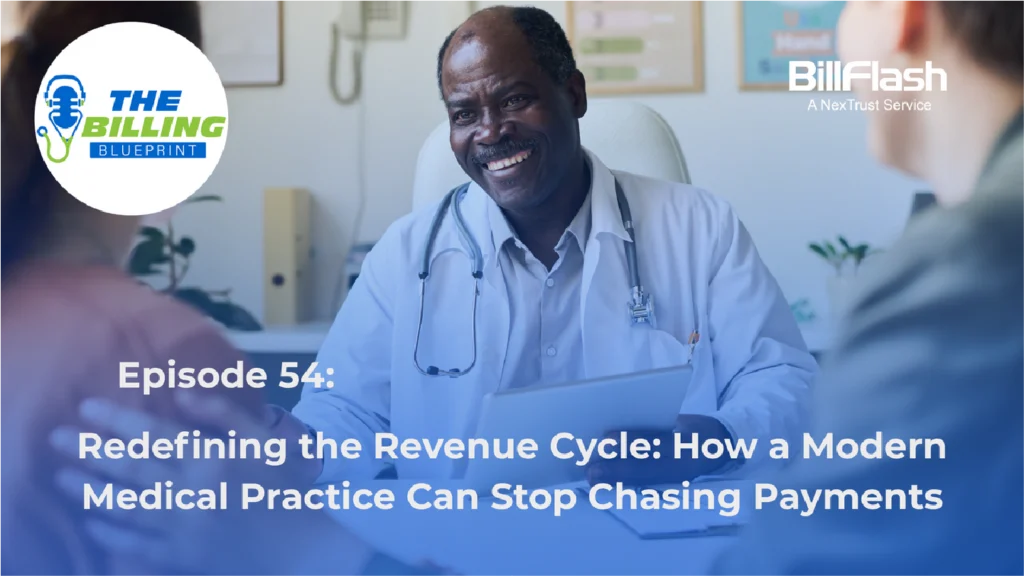
In this episode, we break down why so many medical and dental practices are trapped in a costly, exhausting cycle of chasing payments—and how evolving into a modern medical practice can help break free.
We explore the hidden costs of manual billing, the rise in A/R days despite point-of-service collection efforts, and the growing demand from patients for digital, consumer-friendly payment experiences. We outline five proven strategies high-performing practices use to streamline billing: pre-visit payment requests, simplified statements, automated reminders, multi-channel payment options, and flexible financing plans.
We also explain how modern automation eliminates administrative bottlenecks, improves staff efficiency, shortens the time to payment, and leads to a smoother, more predictable revenue cycle. A must-listen for any practice ready to modernize and finally shift from chasing to receiving.
Transcript
Narrator: 00:00
Welcome to the Billing Blueprint Podcast, your go to resource for innovative medical billing solutions. Each episode we explore the latest industry trends and share proven strategies to help your practice streamline operations and get paid faster. Now here are your hosts, Brad and Sarah.
Sarah: 00:22
Welcome back to the Deep Dive. If you or your team manages the revenue cycle for a medical practice, a dental office, really any healthcare provider, you know this feeling the absolute drain of chasing payments.
Brad: 00:37
Oh, yeah
Sarah: 00:39
I mean, it's the hours spent printing, folding, stuffing envelopes, reconciling all these little partial payments and then making those endless low return reminder calls.
Brad: 00:47
It's the high effort, low reward core of the whole traditional revenue cycle. And frankly, the data suggests that this current, you know, friction heavy payment experience, it's actively sabotaging staff efficiency and it's really frustrating patients.
Sarah: 01:01
So the mission for this Deep Dive is to isolate the critical shift that's happening right now. We're going to get under the surface and identify how smart medical practices are just abandoning the chaos of manual chasing. They're reframing their whole revenue collection strategy around two core pillars, clarity and automation. The goal is to make the payment process so seamless that the money just moves faster and everyone involved, staff and patient, has a better experience.
Brad: 01:25
And this shift is, I mean, it's more urgent than ever because the current methods are failing on a massive scale. What's truly fascinating is when you look at the industry benchmark data. Despite all these efforts to improve collections at the point of service, you know, asking patients to pay co pays right at the check in desk, the true accounts receivable days or AR days, they actually increase from 2023 to 2024.
Sarah: 01:51
Wait, hold on. If providers were getting better at asking for payment earlier or why did the overall time it takes to get paid go up?
Brad: 01:59
Because that one interaction didn't solve the problem. It just shifted the remaining balance to the back end where it got stuck in that same manual post visit collection cycle we're talking about, the process after the visit is still fundamentally broken.
Sarah: 02:12
That brings us directly to our first section. The catastrophic but often hidden costs of relying on these manual collection methods. When we talk about chasing payments, the first thing people think about is, you know, paper and postage. But that's a distraction.
Brad: 02:24
It is. The real price is paid in staff burnout and just massive front office inefficiency.
Sarah: 02:30
Let's break that down a bit.
Brad: 02:31
Okay, so imagine a staff member spending say two hours a day on the phone.
Sarah: 02:35
Yeah.
Brad: 02:36
And they're not talking to new patients, they're chasing 60 day old balances, they're dealing with confused patients, repetitive data entry, tracing, payment errors, all stemming from statements.
Sarah: 02:47
That don't make sense.
Brad: 02:47
Exactly. And constantly reconciling these little partial payments. That operational friction just pulls your best employees away from mission critical tasks.
Sarah: 02:58
Right. You can't focus on high value patient service like scheduling complex procedures or providing that pre visit assistance when you're constantly pulled back to sorting and stuffing envelopes. It's just chaos.
Brad: 03:09
It is the cycle of inefficiency means tasks that should be automated just end up requiring multiple human handoffs and hours of tracing. It creates an environment where practice leaders can't even accurately evaluate their cash flow.
Sarah: 03:21
And then there's what you could call the patient experience tax. If a statement is baffling, you know, full of medical codes and weird adjustments, or if paying it means calling in, waiting on hold, patient confidence just craters.
Brad: 03:34
And they might delay payment simply because they need clarification. And every time a patient calls to ask, what does this mean? Or how do I pay this? That's staff time diverted.
Sarah: 03:43
So you contrast that with practices that use clear, you know, consumer friendly digital options.
Brad: 03:49
Right? When you align payment methods with what consumers actually prefer, you eliminate all those friction points. You shorten that path from the patient thinking, I owe this to them actually completing the action I paid this.
Sarah: 04:01
This is where the evidence for automation really scales up, isn't it? If we look at the bigger picture, organizations like the CAQH, and that's the.
Brad: 04:10
Council for Affordable Quality Healthcare, yeah, they.
Sarah: 04:12
Estimate that there are system wide savings available in the billions, billions just by shifting from manual human interaction to automated electronic transactions.
Brad: 04:23
And that finding is key. It proves this isn't a small problem you can fix by hiring one more person to make calls. The manual approach is just institutionally costly. The solution isn't more effort, it's a better automated process.
Sarah: 04:36
That strong evidence for automation moves us into our next section, understanding why digital solutions are now absolutely non-negotiable. Healthcare needs to stop comparing itself to other clinics and start comparing itself to, well, every other industry a consumer deals with.
Brad: 04:52
It's about meeting the patient where they already are. I mean, the data is just compelling. 85% of consumers today prefer electronic payment methods for medical bills.
Sarah: 05:01
85%.
Brad: 05:02
And think about tech adoption. 9 in 10 U.S. adults, that's 91% own a smartphone. This makes secure mobile links, automated texts and QR codes practical for pretty much every single patient demographic.
Sarah: 05:16
And these people are already doing digital transactions multiple times a day. We see data from late 2023 showing US consumers averaged over 45 transactions a month, mostly with credit and debit cards. They are ready to pay immediately digitally.
Brad: 05:29
The provider just needs to offer that same smooth path they get from Amazon or their utility company.
Sarah: 05:34
So what's fascinating here is how smart practices translate this consumer preference into actual staff efficiency. They realize they don't win by being more aggressive or making more calls.
Brad: 05:45
No, they win by minimizing friction by ensuring the patient is actually happy with the payment process.
Sarah: 05:52
Okay, let me play devil's advocate for a minute. We see the smartphone stats, but what about that other 9% or you know, older demographics who still really rely on paper and mail? Are we creating a new burden for them?
Brad: 06:05
It's a really important question and it dictates the strategy. The goal of automation isn't to eliminate paper entirely. It's to make sure that the default, the easiest path is digital.
Sarah: 06:16
Okay.
Brad: 06:16
And for those patients who do prefer paper, the system still needs to streamline that. You do that by outsourcing the physical mailing, which we can talk about, and making sure even the paper bill has a bridge to the digital world. The key is offering choice, but making the digital choice the most efficient for everyone.
Sarah: 06:31
Okay, so let's look at the upside. If a practice stops spending all those hours printing, stuffing, stamping, where do they reinvest that reclaimed time?
Brad: 06:40
They reinvested into high value tasks that directly impact patient care and retention. Staff can finally focus on improving patient access, providing personalized pre visit assistance, streamlining.
Sarah: 06:51
Complex scheduling and resolving only the real problem.
Brad: 06:54
Exactly. Only the true non routine financial issues. I mean, it's a complete quality of life upgrade for the staff. And, and it leads to much smoother patient registration and retention.
Sarah: 07:04
That shift from low value effort to high value service is the core promise here. So let's get specific. What are the top five proven strategies that practices are using right now to stop chasing and start receiving?
Brad: 07:16
Right. These five strategies are all about engaging earlier, making communication crystal clear, and then maintaining that payment momentum through automation.
Sarah: 07:24
Okay, strategy number one. Use upfront payment requests or pre-visit billing. This sounds like shifting collection from a post visit surprise to a pre visit expectation.
Brad: 07:34
Precisely for scheduled appointments. Practices should be using tools that let them send the patient a text or email with a secure payment link. This shows the estimated patient responsibility in advance of the appointment.
Sarah: 07:46
That's huge for transparency.
Brad: 07:48
It is. It reduces that post visit sticker shock and it works for both in office visits and telehealth.
Sarah: 07:55
Alright, strategy two, simplify statements to eliminate confusion, you have to tackle that patient experience Tax we talked about.
Brad: 08:03
Exactly. Statements have to be in clear, plain language. The patient needs to easily see what service was done, how much insurance paid and what's left. And critically, there has to be consistency.
Sarah: 08:15
What do you mean by that?
Brad: 08:16
The terms used on the paper statement, in the email and the text message and on the payment portal, they should all match perfectly. No confusion.
Sarah: 08:23
And the beauty of system integration here is that it kills the most tedious parts of this, right? I mean, software can let practices outsource the physical mailing of statements.
Brad: 08:32
Yes. That eliminates the need for staff to manually print stuff, stamp and haul bills to the post office. And that outsourcing is incredibly efficient. It means the system can process and mail bills the very next business day after insurance pays, which dramatically shortens the time to payment.
Sarah: 08:51
That speed leads right into strategy number three. Start with automated payment reminders and follow ups. This is where we replace the heavy lift of the manual phone call.
Brad: 09:00
This is the automation workhorse. You replace those sporadic labor intensive manual calls with a scheduled text and email system. The system automatically sends reminders at regular intervals, which just keeps the momentum high.
Sarah: 09:12
And what's the most critical technical detail.
Brad: 09:15
Here, the absolute most critical detail is that the reminders have to automatically stop the instant a patient picks.
Sarah: 09:20
Oh, that's smart.
Brad: 09:21
It ensures the patient is informed without feeling harassed or getting messages that are already out of date. That is a major driver of frustration.
Sarah: 09:29
Okay, on to number four. Offer multiple patient friendly payment channels. It's about accessibility, total accessibility.
Brad: 09:37
You have to meet the patient where they are. You need a secure mobile friendly payment page that works perfectly on a phone. You need secure links and emails and texts. And your in office options have to be modern. Tap to pay cards, checks, mobile wallets.
Sarah: 09:51
And I remember we talked about how this bridges the gap for paper preferring patients too.
Brad: 09:55
Yes, the critical bridge for that group is putting a scannable QR code on the mailed bill. This ensures that every pathway, even the physical one, leads them directly to the secure online portal for instant payment. No typing in long URLs or account numbers.
Sarah: 10:11
Finally, strategy number five. Implement flexible payment plans and financing. This gets at the fact that for bigger balances, it's often about affordability, not unwillingness to pay.
Brad: 10:22
And that flexibility is essential for retention and cash flow. Offering automated options like structured installment plans or authorized recurring drafts manages those larger balances digitally. It reduces all the administrative overhead of manual tracking and keeps the patient engaged.
Sarah: 10:37
Let's deepen the dive into that final point. Because affordability is often the biggest hurdle when a Patient owes a significant amount. Offering immediate flexible financing can be a total game changer.
Brad: 10:49
It is, especially when the solution is designed to insulate the provider from the credit risk. That's the core appeal of these patient financing programs. They let patients manage balances through monthly installments, removing that immediate barrier to care.
Sarah: 11:02
The benefit for the patient is obvious, but what is the transformative benefit for the provider?
Brad: 11:08
The transformative benefit is this. The provider receives full payment immediately from the financing company.
Sarah: 11:14
Wow.
Brad: 11:14
And the crucial part is that the financing company takes on 100% of the risk. There is no recourse back to the provider. If the patient defaults on those payments.
Sarah: 11:24
That is a massive transfer of risk. So the provider is basically trading potential long term bad debt for immediate guaranteed payment. How does that, how does that work financially?
Brad: 11:33
Well, the provider agrees to a small transaction fee or a discount, which is almost always far less than the cost of their own manual collection efforts and eventual write offs. This lets the financing partner underwrite the debt and manage the risk. And it clears the balance from the practice's books instantly.
Sarah: 11:51
And for the patient, this can't just be another complicated loan application. It has to be accessible.
Brad: 11:56
That's the high value detail. These systems are designed for speed and high approval. The online application often takes less than a minute. They typically don't require a hard credit check, which is a huge hurdle to overcome.
Sarah: 12:08
And approval rates.
Brad: 12:09
The systems we're seeing boast approval rates near 90%. And critically, every approved patient is guaranteed to get a 0% interest option for a set period. It makes it truly accessible.
Sarah: 12:21
So how does a practice handle all these moving parts? The pre visit requests, automated reminders, the financing without it turning into an IT nightmare.
Brad: 12:28
That's the ultimate proof of an effective automated workflow. These modern payment systems are designed for deep integration. They connect seamlessly with hundreds of different EHR and practice management systems. This ensures balances flow in easily. Statements get generated with a few clicks. Reminders run silently in the background.
Sarah: 12:47
And all the payments post back automatically.
Brad: 12:49
Exactly. All payments post back automatically. That's how you lower staff burnout while boosting cash flow predictability.
Sarah: 12:56
This deep dive really shows that modernization just fundamentally changes the economics of patient collection. The expected results seem shorter AR cycles, predictable cash flow, lower collection costs, and maybe most importantly, happier staff and happier patients.
Brad: 13:12
Absolutely. The final thought we want to leave you with is a contrast between the old model and the new. The goal of this isn't just about getting money faster. It's about reclaiming staff time.
Sarah: 13:22
Time that's desperately needed for patient care and practice growth instead of just printing, dialing and reconcile the old way turned.
Brad: 13:29
Billing into this frustrating, repetitive series of staff handoffs and patient resistance.
Sarah: 13:35
Modern Automation Connecting all these pieces we've talked about, it turns billing from an administrative black hole into a predictable, simple, automated workflow.
Brad: 13:44
So we'd encourage you to really explore whether your current processes are built around working harder or working smarter. Compare your system to those five key strategies we discussed today and see if your technology is truly enabling a modern revenue cycle that supports both your financial health and your staff's sanity.
Narrator: 14:01
Thanks for tuning into the Billing Blueprint podcast. For more insights or to dive deeper dive deeper into today's topics. Head over to billflash.com. Don't forget to subscribe and we'll catch you next week with more strategies to keep your practice running smoothly and getting paid faster
Sources:
Stop Chasing Payments—Smart Medical Practices Do This Instead