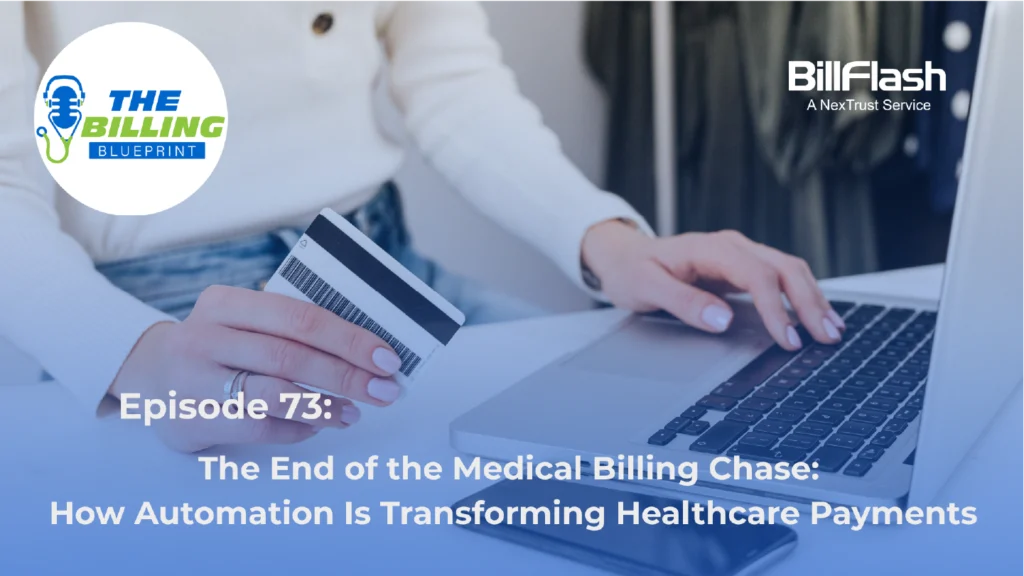
This podcast explores the growing disconnect between cutting-edge medical care and outdated billing processes, focusing on the decline of the medical billing chase. As healthcare costs shift more responsibility onto patients through high deductibles, the traditional approach—where providers spend weeks or months chasing down payments—has become inefficient, costly, and frustrating for everyone involved.
By eliminating friction and making the process more immediate and understandable, automation not only improves cash flow for practices but also creates a more respectful, convenient experience for patients. Ultimately, the decline of the medical billing chase marks a broader shift toward clarity, efficiency, and trust in the financial side of healthcare.
Tune in today.
Transcript
Narrator: 00:00
Welcome to the Billing Blueprint Podcast, your go to resource for innovative medical billing solutions. Each episode we explore the latest industry trends and share proven strategies to help your practice streamline operations and get paid faster. Now here are your hosts, Brad and Sarah.
Brad: 00:20
Imagine stepping out of a, you know, a really pristine, state of the art medical suite.
Sarah: 00:28
Oh, yeah, like one of those places that looks like a spaceship.
Brad: 00:31
Exactly. You’ve just been examined using like an MRI machine that costs literally millions of dollars. The doctor has your complete medical history right there on a glowing tablet. And the clinical science is basically bordering on science fiction. It is an absolute marvel.
Sarah: 00:45
It really is. The clinical side of modern medicine is just so hyper focused, precise and entirely geared towards healing.
Brad: 00:55
Right? But then you walk out of that exam room, you approach the front desk and. And suddenly you are violently transported back to like a 1995 accounting firm.
Sarah: 01:04
Oh, man. Yeah, the contrast is jarring.
Brad: 01:08
It really is. You’re looking at overflowing paper trays, you’re hearing the actual sound of a fax machine in the background and watching a stressed out administrator shuffle through sticky notes. It’s just a completely jarring disconnect.
Sarah: 01:20
That front desk is the absolute definition of an administrative bottle. You have this incredible futuristic clip clinical experience crashing headfirst into, well, an entirely analog financial reality.
Brad: 01:32
And that massive disconnect is exactly why we are here today. Welcome today’s Deep Dive where we are exploring a surprisingly dramatic shift happening right now in the healthcare industry, which is the death of the medical billing chase.
Sarah: 01:44
And it is definitely dying.
Brad: 01:45
Good riddance, honestly. So we are pulling our insights today from a really comprehensive 2026 article by BillFlash. It’s titled Automated Patient Billing Getting Paid Easier in 2026, which is a great.
Sarah: 01:56
Breakdown of what’s actually happening on the ground.
Brad: 01:58
Yeah, it is. So our mission for you today is to really dig into why medical practices are abandoning manual billing, how automation is stepping in to rescue their cash flow, and ultimately what this means for both the businesses providing the care and of course, you, the patient receiving it. Right, okay, let’s unpack this. Because on the surface, medical billing sounds like the driest topic imaginable.
Sarah: 02:20
It does, and it really does.
Brad: 02:21
But it’s actually a brilliant lens into human behavior, psychology, and, you know, modern business survival.
Sarah: 02:29
What’s fascinating here is that the core tension in healthcare right now actually has nothing to do with medicine.
Brad: 02:36
Wait, really? Nothing at all?
Sarah: 02:38
Pretty much. If you look at recent Pym NTS research, the biggest digital bottleneck in the entire healthcare system isn’t delivering the Medical care itself. It’s the administrative and payment workflows that follow the care.
Brad: 02:51
Oh, wow.
Sarah: 02:51
Yeah. The patient’s financial journey is basically the weakest link in the entire chain, and it’s threatening to break the system.
Brad: 02:58
Well, to really grasp why automation is suddenly the number one priority across the board, we have to look at why the old system completely broke down. We’re looking at, like, a perfect storm that is currently sinking manual billing.
Sarah: 03:10
Yeah, a very expensive storm.
Brad: 03:12
Exactly. Let’s start with the financial burden, because it has heavily shifted onto the patient. According to the source material, in 2024, 87% of workers in employer health plans had annual deductible.
Sarah: 03:24
And that is a critical number. But we have to look at the size of those deductibles too, Right? The average single deductible was about $1787. Furthermore, nearly a third of people are in plans where that deductible actually exceeds $2,000.
Brad: 03:40
I just want to pause on that for a second because we hear these numbers all the time. But think about what that actually means for a normal household budget.
Sarah: 03:46
It’s huge.
Brad: 03:47
Right before your insurance even really steps in to help with the heavy lifting, you are on the hook for $2,000 out of pocket. That is a massive chunk of change.
Sarah: 03:55
It is a profound shift in the economic reality of healthcare. I mean, decades ago, manual billing workflows actually made sense because things were cheaper. Well, they were built for an era where your insurance covered 90 or 95% of the costs. The patient might be left with a tiny $10 or $20 copay.
Brad: 04:14
Oh, right, the classic copay.
Sarah: 04:15
Exactly. And if that small balance took a few weeks to collect, it didn’t, you know, bankrupt the doctor’s office. But with these modern high-deductible plans, the burden has shifted dramatically.
Brad: 04:26
Makes sense.
Sarah: 04:27
Practices are no longer just negotiating with massive insurance conglomerates. They have effectively been forced to become consumer debt collectors, which is a role.
Brad: 04:35
They were never built for. I mean, doctors went to medical school to heal people, not to run a collection agency.
Sarah: 04:39
Exactly.
Brad: 04:40
And while the patients are obviously feeling the squeeze of these high costs, the medical practices are getting absolutely crushed on the back end too. The Source says nearly nine in 10 medical groups reported higher expenses in 2025.
Sarah: 04:52
Nine in 10. Their profit margins are practically nonexistent right now.
Brad: 04:56
Right. And here’s where the old system finally snaps. Over 70% of providers say collecting patient balances takes a month or more, a.
Sarah: 05:04
Whole month just to get paid.
Brad: 05:06
And roughly 25% of payments to small providers are arriving Way past their due date. Think about how absurd that is in literally any other industry.
Sarah: 05:17
It really puts it into perspective.
Brad: 05:18
It’s like running a restaurant where the customers come in, they eat, they leave, and then the staff has to spend the next month mailing them letters, begging them to pay for their meal.
Sarah: 05:28
Right.
Brad: 05:28
You go out of business in a week, it’s totally unsustainable.
Sarah: 05:31
That restaurant analogy perfectly captures the absurdity of the delayed transaction. Can you imagine the overhead was required to track down thousands of diners weeks after a meal?
Brad: 05:40
It would be a nightmare.
Sarah: 05:41
That is precisely what healthcare administrative teams are doing every single day. They are spending hours manually printing out statements, folding them, stamping them, and tracking endless follow ups.
Brad: 05:51
Ugh, the folding and the stamping.
Sarah: 05:53
And then comes the phone calls. Staff members forced to make phone calls during normal business hours to track down payments.
Brad: 05:59
Right. Which is a terrible experience for everyone. Like if I’m at work and I see my doctor’s number pop up on my phone, my heart drops because I immediately think it’s bad news about a test result.
Sarah: 06:08
Oh, for sure. The anxiety is real.
Brad: 06:10
Right? And then I answer it in the middle of a quiet office and it’s just Brenda from accounting asking me to pay $150 over the phone.
Sarah: 06:19
Exactly. It causes massive anxiety for the patient. And honestly, it causes immense burnout for the staff making those calls. Nobody wants to be a debt collector.
Brad: 06:28
Yeah, Brenda hates it too.
Sarah: 06:29
And the financial result is their accounts receivable, which is really just the accounting term for money that is owed to them but hasn’t been paid yet. It just skyrockets.
Brad: 06:37
Because human beings are the bottleneck.
Sarah: 06:39
Right. When a collection process relies entirely on a human being having the free time to print a letter or make a call, reminders get sent late or they just get forgotten entirely. And the universal rule of debt is that the longer a balance sits unpaid, the less likely it is to ever be collected.
Brad: 06:54
So the manual system is officially failing. It is a complete lose for the patient and the practice. Which brings us to the cure being proposed across the entire industry right now in 2026, which is automation.
Sarah: 07:07
Yes, the big pivot.
Brad: 07:08
According to a recent MGMA Stat poll, medical groups are making automation their absolute top cost cutting move this year. But let’s define what we are actually talking about here.
Sarah: 07:18
That’s important. People hear automation and they think of sci fi.
Brad: 07:21
Yeah. According to the Bill Flash article, automated patient billing is defined as connected workflows for delivering bills, reminding patients, and collecting payments with minimal staff intervention.
Sarah: 07:31
That’s right. The goal is replacing the severe inefficiency of manual tracking. It completely replaces those printed statements sitting in a tray waiting for someone to find a roll of stamps, thank goodness. And it replaces the inconsistent, awkward phone follow ups. But we need to be very careful to clarify what automation does not replace.
Brad: 07:49
Oh, what doesn’t it replace?
Sarah: 07:51
It does not replace human oversight, and it certainly does not replace compassion. The medical practices are still entirely in control. They set the rules, they determine how flexible the payment options are, and they dictate the tone of the communication.
Brad: 08:04
Okay, I have to stop you there and play devil’s advocate for a second because I want to push back on that.
Sarah: 08:07
Sure, go ahead.
Brad: 08:08
When you say minimal staff intervention, I immediately hear like, Kelis robot.
Sarah: 08:13
Right. Right.
Brad: 08:13
If I’m a patient and I’ve just gotten a scary diagnosis and I’m staring down a massive, confusing medical bill, the absolute last thing I want is a cold automated robot harassing me via text message. That feels pretty dystopian. Where is the empathy in that?
Sarah: 08:29
You know, that is a completely natural assumption to make. And it’s a concern many practices initially share when they switch over. But the data, and more importantly, the actual patient feedback show the exact opposite reality.
Brad: 08:42
Really? The opposite?
Sarah: 08:43
Yeah, we have to compare it to the alternative. Think deeply about the manual billing experience you just defended.
Brad: 08:48
Okay.
Sarah: 08:49
Getting a vague, confusing paper statement three or four weeks after your visit, long after you’ve completely lost the context of the appointment. Is that empathetic?
Brad: 08:57
Well, no, that’s annoying.
Sarah: 08:58
It breeds distrust. You open this letter and your left wondering, what exactly is this charge for? Didn’t my insurance cover this? Did the doctor make a mistake?
Brad: 09:06
That’s a fair point. The element of surprise is huge. It feels almost like a trap.
Sarah: 09:10
Yes, the surprise and the delay create major friction. True automation actually increases transparency and trust. Instead of a vague paper bill arriving a month later, you receive a clear itemized digital notification immediately while the visit is still fresh in your mind.
Brad: 09:26
So you know exactly what you’re paying for.
Sarah: 09:28
Exactly. You can clearly see what you owe, what insurance covered and what your options are. And crucially, going back to your point about the phone calls, it saves the patient from the deep embarrassment of having to negotiate debt with a human being during their workday.
Brad: 09:41
Oh, yeah, the office phone call.
Sarah: 09:42
Right. The automated system is just a gentle, clear, private prompt. It removes the friction, and more importantly, it removes the shame.
Brad: 09:50
Okay, I can see you got me. You’re replacing an awkward human confrontation with a clear, private digital pathway. I can definitely see how clarity is its own form of compassion.
Sarah: 10:00
It really is.
Brad: 10:02
So if we accept that, let’s look at the physical mechanics of this. How does this technology actually alter the revenue cycle for a medical practice on a day-to-day basis?
Sarah: 10:11
Well, it starts at the very beginning with delivery. Digital notifications, whether that is a text or an email, hit the patient’s phone the exact same day a charge is posted to their account.
Brad: 10:20
Wow. Same day.
Sarah: 10:21
The speed of that delivery is critical for context. But what about patients who still prefer paper?
Brad: 10:27
Right. Not everyone wants a text.
Sarah: 10:29
Exactly. That process is completely automated too. The system generates and mails a physical paper statement the very next day automatically, without the office staff ever having touch a printer or a stamp.
Brad: 10:40
That is wild.
Sarah: 10:41
And here is a brilliant physical mechanic. Those paper bills now include QR codes.
Brad: 10:46
Oh, I noticed that in the source. A QR code on a paper medical bill is such a smart bridge.
Sarah: 10:51
It is, isn’t it?
Brad: 10:53
Yeah, because you might want the physical paper for your personal records, but you definitely don’t want to DEG out your checkbook, write a physical check, find an envelope and walk to the mailbox.
Sarah: 11:00
Nobody wants to do that anymore.
Brad: 11:01
Right? You just scan the paper with your phone and pay digitally.
Sarah: 11:04
Precisely. It bridges the gap between the analog preference and the digital convenience. And then we move to the mechanics of the reminders. Okay, the system sends scheduled text and email reminders based on rules the practice sets. But here is the most important mechanical detail. Those reminders stop automatically the exact second a payment is made.
Brad: 11:26
Which is huge. There is literally nothing more frustrating than mailing a check or paying online and then still getting three automated phone calls over the next week. Because the systems don’t talk to each other.
Sarah: 11:35
Exactly. And alongside the smart room reminders, you have to pair self-serve payment options. Patients need choices.
Brad: 11:42
Yeah, flexibility is key.
Sarah: 11:43
In 2026, a practice simply cannot survive if they only accept a mailed check or a phone call with a credit card.
Brad: 11:50
Right.
Sarah: 11:50
These automation platforms provide links to digital wallets like Apple Pay and Google Pay. They facilitate ACH transfers, which for those unfamiliar is an automated clearinghouse transfer. Basically just a direct secure bank to bank payment.
Brad: 12:05
So easy.
Sarah: 12:05
Right. They take standard card payments and they allow patients to easily set up installment plans or auto pay, all from their smartphone while sitting on their couch at 9PM.
Brad: 12:13
So what does this all mean? Well, if you have ever found yourself ignoring the medical bill for a week simply because you didn’t have a physical stamp in your house, this entire system is designed specifically to remove that exact.
Sarah: 12:25
Friction for you it is entirely about removing friction. And there is a massive proactive push happening behind the scenes in the financial world that is actively forcing medical practices to adopt this convenience model.
Brad: 12:38
Oh, what kind of push?
Sarah: 12:40
This is a crucial detail. Many major credit bureaus no longer report small medical debts on consumer credit reports.
Brad: 12:47
Wait, really?
Sarah: 12:48
Yeah.
Brad: 12:48
So the threat of a ruined credit score, which, let’s be honest, was the ultimate stick used to threaten people into paying, is just gone for small medical bills?
Sarah: 12:56
Yes, it is. From a consumer protection standpoint, medical debt is often involuntary. You don’t choose to get sick the way you choose to buy. Like a massive television on a credit card.
Brad: 13:07
Right. That totally makes sense.
Sarah: 13:08
Because of that, the credit bureaus shifted their policies. But the consequence for the medical practice is that the outside incentive for patients to pay quickly has been entirely removed.
Brad: 13:18
Oh, I see.
Sarah: 13:19
The big stick is gone. So providers can no longer rely on fear or consequences to get paid. They have to rely on convenience.
Brad: 13:26
Wow.
Sarah: 13:26
They are forced to use automation to shrink their accounts receivable window before the patient just forgets about the bill entirely.
Brad: 13:32
Right, so if we connect this to the bigger picture, that fundamentally changes the strategy.
Sarah: 13:36
It does. It changes what we call revenue cycle management or RCM. Top performing medical groups are currently collecting significantly more money in that crucial 0 to 30 day window right after the appointment.
Brad: 13:49
Because they make it easy.
Sarah: 13:50
Exactly. Because they use these automated tools to catch payments early, they are keeping those accounts from aging into the 120 day mark.
Brad: 14:00
And just to ground that B2B statistic for everyone listening, that 120 day mark is that awful moment when you’re cleaning your kitchen counter, you find a crumpled coffee stained medical bill at the bottom of your mail pile from four months ago and you just feel a pit in your stomach.
Sarah: 14:20
Exactly. We’ve all been there. And at 120 days, it usually turns into bad debt that never gets paid.
Brad: 14:25
Right.
Sarah: 14:26
By utilizing automation to get paid in the first 30 days, the practice arrives, and by freeing up their human staff from routine low level collections, those highly trained employees can actually spend their time tackling complex root cause financial issues.
Brad: 14:41
Oh, like dealing with the insurance companies?
Sarah: 14:43
Yes. They can fight with the massive insurance companies over denied claims rather than harassing a patient over a $20 copay.
Brad: 14:50
That makes so much sense. To really understand what this looks like in practice, the source article uses the bill flash ecosystem as its prime example.
Sarah: 14:59
It’s a great example.
Brad: 15:00
It’s basically a playbook for what a fully integrated modern platform looks like right now in 2026. And it starts with a feature called PreBill, which I think is a massive paradigm shift.
Sarah: 15:10
PreBill is entirely revolutionary for the industry.
Brad: 15:13
Really? How does it work?
Sarah: 15:15
So before the medical visit even happens, the system calculates and sends the patient the full estimated cost of care pre insurance, so the patient can prepare financially or even just pay upfront before they walk in the door.
Brad: 15:26
Here’s where it gets really interesting. PreBill is like finally getting to look at the menu prices before you order at a restaurant. Yes, in health care, we have basically been ordering blind for decades. You get the treatment and you just pray you can afford it when the check arrives a month later. PreBill completely changes the power dynamic and anxiety levels for the patient. But why couldn’t we do this before?
Sarah: 15:46
Because the manual contracts and legacy systems between providers and insurance companies were just far too opaque and disconnected to provide real time estimations.
Brad: 15:55
gotcha.
Sarah: 15:56
But now the technology allows it. It sets the financial expectation before the care occurs, which, as you said, is incredibly empowering.
Brad: 16:03
Yeah, absolutely.
Sarah: 16:04
Then after the visit, the playbook moves to the e bill and mailed bills sent immediate, as we just discussed. But where bill flash gets highly functional for the patient is with pay reminders and something called plan pay.
Brad: 16:15
PlanPay. Okay, break that down for us.
Sarah: 16:17
Patients might get up to three messages a month, which stop upon payment, of course. But PlanPay allows for self-serve payment plans via a secure online portal called PayWoot.
Brad: 16:28
Wait, so the patient just negotiates their own payment plan without ever talking to a human?
Sarah: 16:32
Yes, but within strict guardrails. Okay, the medical practice sets the rules behind the scenes. They might dictate a minimum balance required to start a plan or the maximum number of months the plan can last.
Brad: 16:43
Okay, that makes sense. Protects the practice.
Sarah: 16:45
Right, but within those rules, the patient logs in and chooses the monthly payment that works for their personal budget. They don’t have to call the office, wait on hold, and verbally negotiate their financial hardship with a complete stranger.
Brad: 16:57
That is incredible. Just the dignity of that alone is huge.
Sarah: 17:00
It really is.
Brad: 17:01
And for the really massive, unexpected bills, the playbook outlines something called flex pay. This is essentially patient financing. The source notes it has a 90% approval rate and it takes the patient less than a minute to apply on their phone.
Sarah: 17:14
Less than a minute. That’s key.
Brad: 17:15
Yeah, but the beauty of this mechanism is that the medical provider gets paid in full, instantly by the financing partner.
Sarah: 17:22
Right, the risk is offloaded.
Brad: 17:24
Exactly. The practice is made whole immediately, and the patient pays off the financing partner over time. Plus, they offer auto pay for keeping credit cards Securely on file. And the article specifically notes this is fully PCI compliant.
Sarah: 17:37
Yes, which is a vital detail. PCI compliance is payment card industry compliance.
Brad: 17:42
Which means.
Sarah: 17:43
It’s a technical term that basically just means bank level fortress. Tight security for your credit card data. You aren’t just writing your Visa number on a clipboard at the front desk for anyone to see.
Brad: 17:54
Thank goodness that is ending. I hated doing that.
Sarah: 17:56
Oh, me too. And finally, they have integrated collections. If a balance really does age out and remain completely unpaid. Despite all of these incredibly convenient options, recovery specialists take over based on the rules the practice set up.
Brad: 18:08
Okay, so it still happens.
Sarah: 18:09
It still happens. But here is the key. The practice doesn’t have to hire a third-party vendor. They don’t have to manually export a bunch of sensitive patient data to a shady outside collection agency.
Brad: 18:20
Oh, wow.
Sarah: 18:20
It is all handled securely within the exact same BillFlash ecosystem.
Brad: 18:24
Which raises an important point about the technology itself. Why does it matter that it’s all in one ecosystem?
Sarah: 18:29
Because the critical advantage here is connection. When a practice’s electronic health record- EHR, the central digital nervous system of the clinic, talks seamlessly to the billing software, the reminders, and the collections, human error vanishes.
Brad: 18:43
Oh, I see.
Sarah: 18:44
You no longer have a stress administrator typing the exact same payment amount into three different disconnected software programs.
Brad: 18:51
Right?
Sarah: 18:51
The payment is made by the patient and. And it is posted and reconciled in the accounting ledger automatically. It is a closed, perfectly clean loop.
Brad: 19:00
So to summarize the mission of this deep dive, today we’ve looked at why the manual medical Billy Chase is officially, permanently dead. Practices aren’t adopting automation just to buy new tech.
Sarah: 19:10
No, not at all.
Brad: 19:11
They are doing it because the manual chase, it’s financially ruining them and completely burning out their staff. By removing friction, automating digital and paper deliveries, and offering flexible payment options like FlexPay and PlanPay, these practices lower their accounts receivable, reduce staff burnout, and actually build better trust with patients.
Sarah: 19:29
Because at the end of the day, clarity is compassion. When you remove the confusion, you build trust.
Brad: 19:34
Exactly. And whether you are a healthcare professional looking to modernize a clinic, a patient who just wants paying a doctor’s bill to be as easy as buying a coffee on your phone. This shift to connected proactive billing fundamentally impacts your daily life. It takes the anxiety right out of the mailbox.
Sarah: 19:51
It really does. And I want to leave you, the listener, with a final thought to mull over as we wrap up today.
Brad: 19:55
Lay it on us.
Sarah: 19:56
This whole deep dive into medical billing actually reveals something fascinating about human psychology. Okay, often when people fail to pay a debt or fail to take an action, it isn’t actually a lack of willingness or a desire to be difficult. It is simply a natural reaction to friction and confusion.
Brad: 20:12
Oh, that’s so true.
Sarah: 20:13
So as you go about your week, I challenge you to ask yourself, where else in your business or even in your personal life are you interpreting someone’s lack of action as stubborn resistance when the reality is you just haven’t made the process clear and easy enough for them?
Brad: 20:27
I absolutely love that perspective. Maybe they aren’t ignoring you. Maybe you just didn’t give them a clear path forward or a QR code. We don’t need the front desk of a doctor’s office to feel like a 1995 accounting firm anymore. We can finally let the administrative side of healthcare be as modern, precise and sophisticated as the medicine happening inside the exam room. Thank you so much for joining us on this deep dive. We’ll catch you next time.
Narrator 21:02
Thanks for tuning into the Billing Blueprint podcast. For more insights or to dive deeper dive deeper into today’s topics. Head over to billflash.com. Don’t forget to subscribe and we’ll catch you next week with more strategies to keep your practice running smoothly and getting paid faster
Sources:
Automated Patient Billing in 2026: How Practices Are Getting Paid Without the Chase